

Numerical Analysis
Validated by University of Essex Online
Duration
13 weeksStudy Mode
OnlineTotal Tuition
£1,492Monthly Payment
£485Qualification
Micro-Credentials / Short CoursesStart Date
July, OctoberProgramme Overview
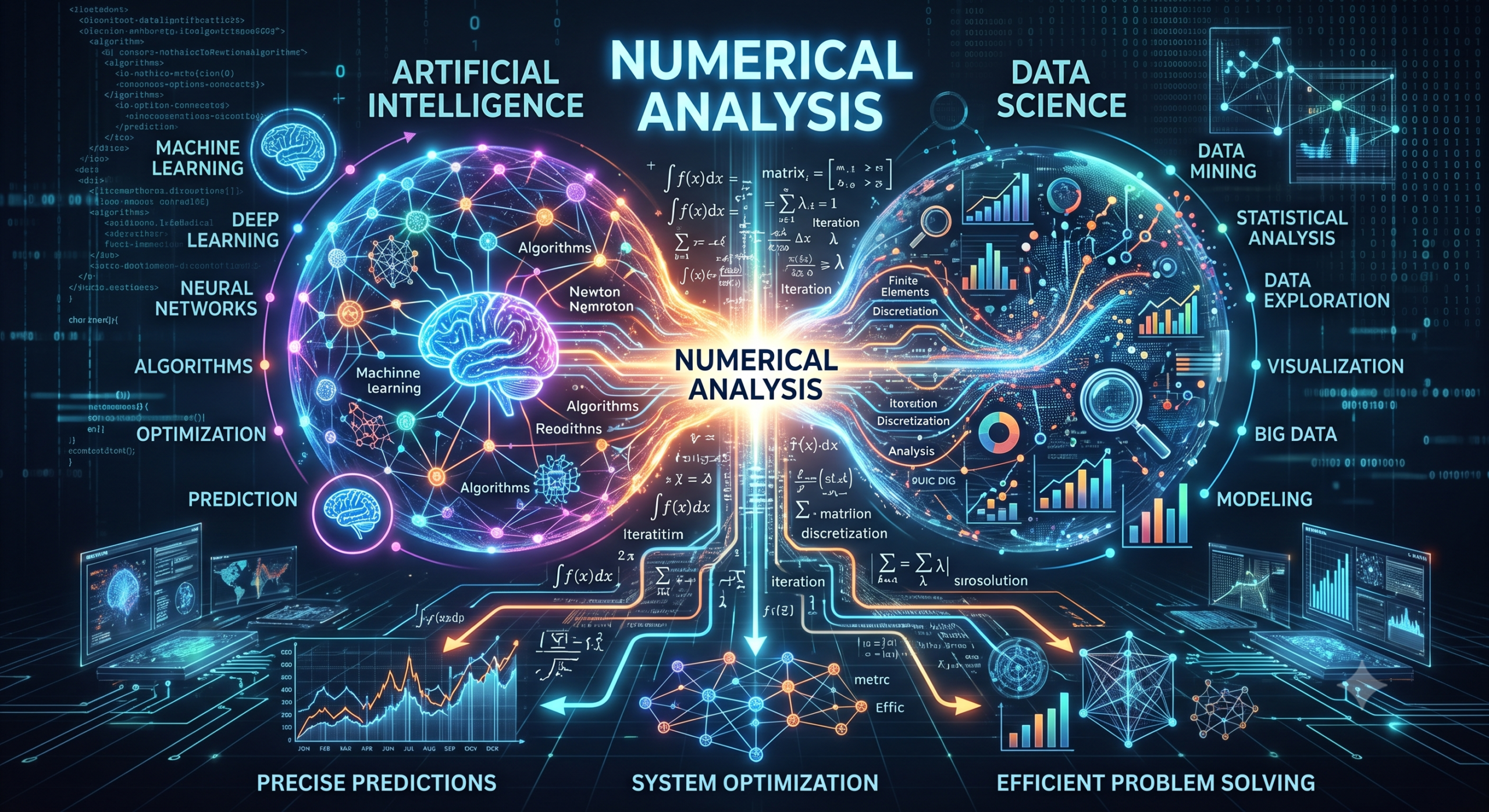
he Numerical Analysis online professional course from the University of Essex Online is designed to build a strong foundation in the mathematical and statistical techniques that underpin modern data science, artificial intelligence (AI) and computational problem-solving. Over 13 weeks, students learn how to analyse complex datasets, apply mathematical models, interpret statistical results and communicate findings for informed decision-making. For Caribbean professionals and graduates seeking to enter the rapidly expanding fields of AI, data analytics, fintech, healthcare analytics, engineering, government planning and digital transformation, this programme provides practical, career-focused knowledge that can serve as a standalone professional qualification or as a pathway into postgraduate computing programmes.
Entry Requirements
Applicants are expected to meet the following requirements:
No formal academic qualifications or previous experience are required.
A good command of the English language is required.
Applicants whose first language is not English should demonstrate English proficiency equivalent to IELTS Academic 6.5, although the University provides a free online English assessment for applicants without an IELTS certificate.
Who is this course for?
This programme is ideal for:
Graduates considering a future in Data Science or Artificial Intelligence.
IT professionals wishing to strengthen their mathematical foundation.
Software developers seeking analytical and statistical skills.
Engineers interested in computational modelling.
Financial analysts working with quantitative data.
Government statisticians and policy analysts.
Researchers requiring numerical modelling techniques.
Mathematics teachers wishing to update their computational skills.
Business intelligence professionals.
Caribbean professionals preparing for postgraduate study in computing or analytics.
Career Opportunities
Data Analyst
Junior Data Scientist
Artificial Intelligence Analyst
Machine Learning Support Specialist
Business Intelligence Analyst
Financial Data Analyst
Operations Research Analyst
Statistical Analyst
Research Assistant (Computational Sciences)
Quantitative Risk Analyst
Programme Highlights
Students begin by learning how mathematical models are used to solve practical real-world problems. They examine the challenges associated with analysing real datasets, selecting appropriate modelling techniques and understanding how assumptions affect analytical outcomes. This module establishes the analytical mindset needed for careers in data science, engineering and scientific computing.
Linear algebra forms the backbone of modern computing and AI. Students develop an understanding of vectors, matrices and matrix operations while learning how these mathematical tools support machine learning algorithms, computer graphics, optimisation techniques and data analysis. The concepts introduced here become essential building blocks for advanced computing applications.
This section explores mathematical techniques used to model continuous systems and solve complex engineering and scientific problems. Students learn differentiation, numerical integration methods and approximation techniques that enable computers to solve equations where exact analytical solutions are difficult or impossible. These skills are widely applied in engineering, economics, environmental science and AI.
Students gain an understanding of probability theory and uncertainty, learning how to calculate probabilities and model random events. They examine probability distributions and develop the quantitative reasoning needed for predictive analytics, machine learning, financial modelling and risk assessment.
The statistics component introduces the core principles used in evidence-based decision making. Students study confidence intervals, hypothesis testing and Bayesian methods while learning how to interpret data accurately and evaluate the reliability of statistical conclusions. These techniques are fundamental in research, healthcare, finance, public policy and business intelligence.
Related Courses
Advanced Diploma in Information Technology
Qualification: Professional Diploma
Duration: 12 months
Tuition: €4,000
View ProgrammeBachelor of Science in Business Information Technology (IT)
Qualification: Bachelor’s Degree
Duration: 3 Years
Tuition: €12,000
View ProgrammeBachelor of Science (BSc) in Artificial Intelligence
Qualification: Bachelor’s Degree
Duration: 3 years
Tuition: €10,500
View ProgrammeApply for This Programme
You need an UpCaria account before starting your application. Log in to your existing account or create a new one.
🎓 Scholarship Eligibility Checker
Select your country to check whether you may qualify for a scholarship for this programme.