

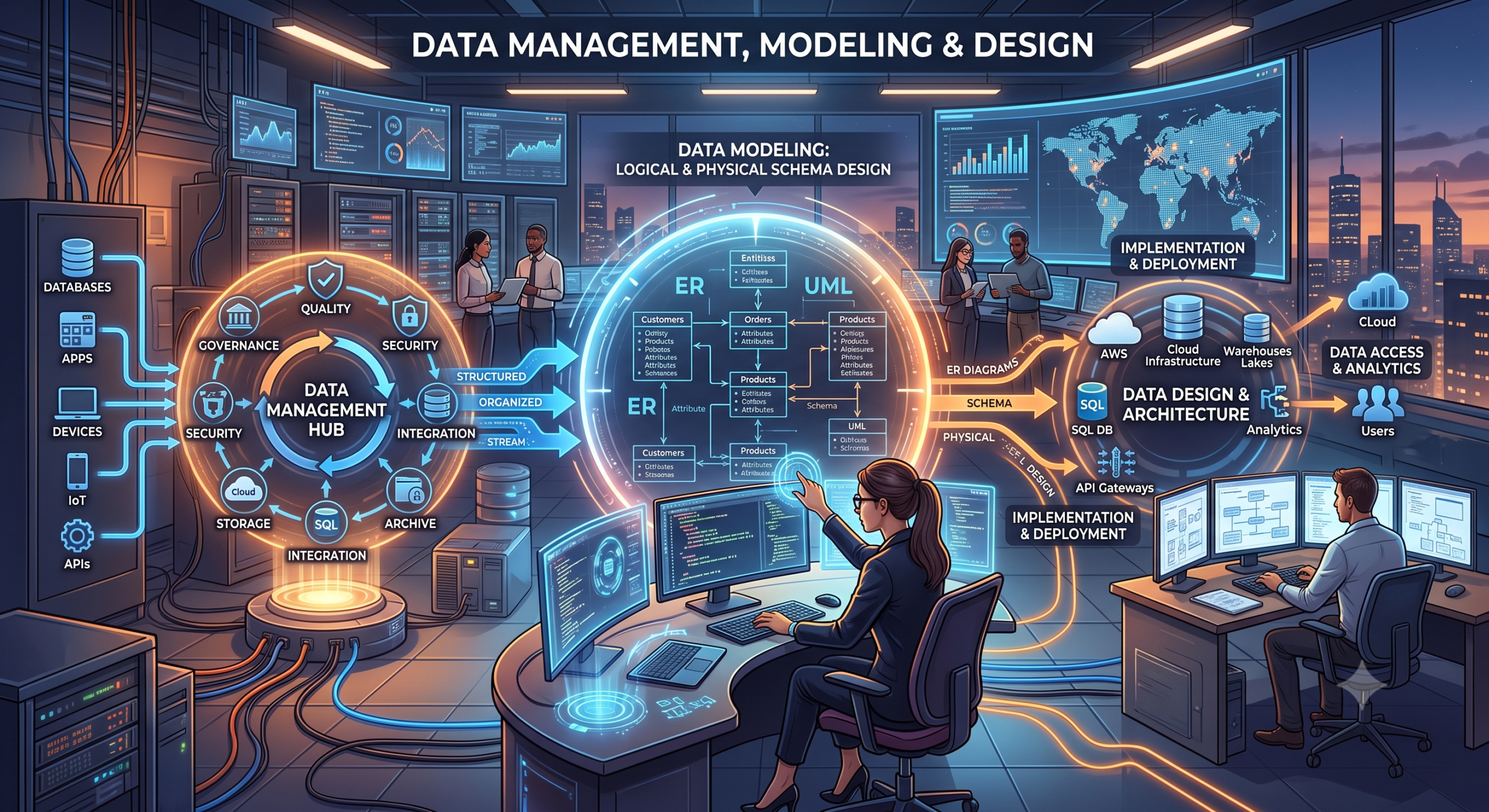
Data Management, Modelling and Design
Validated by University of Essex Online
Duration
13 weeksStudy Mode
OnlineTotal Tuition
£1,492Monthly Payment
£497Qualification
Micro-Credentials / Short CoursesStart Date
OctoberProgramme Overview
The Data Management, Modelling and Design online professional course is a 13-week, part-time postgraduate-level professional course designed to equip professionals with practical skills in managing, organizing, modelling, and analysing business data. Students develop an understanding of modern data management techniques, database technologies, SQL, Python, data pipelines, and both relational and NoSQL databases while exploring emerging trends in big data and cloud technologies. Upon successful completion, students earn 20 UK postgraduate academic credits, which can be transferred into selected Postgraduate Certificate, Postgraduate Diploma, or Master's degree programmes. This flexible online programme is particularly valuable for Caribbean professionals seeking to strengthen their digital and data analytics capabilities without interrupting their careers.
Entry Requirements
Applicants should possess a strong interest in data management, business technology, or digital transformation. The programme welcomes both experienced professionals seeking to upskill and academically qualified graduates wishing to enhance their expertise in modern data management technologies. Since instruction is delivered entirely in English, applicants should demonstrate English language proficiency equivalent to IELTS 6.5, although the University provides a free online English assessment for applicants who do not already possess an approved English qualification.
Who is this course for?
This programme is ideal for:
Business Analysts
Data Analysts
Database Administrators
IT Professionals
Software Developers
Business Intelligence Professionals
Digital Transformation Managers
Operations Managers
Project Managers
Graduates preparing for careers in Data Science
Caribbean professionals seeking internationally recognized digital skills
Career Opportunities
Data Analyst
Business Intelligence Analyst
Database Administrator
Data Management Specialist
Business Systems Analyst
Data Quality Manager
Data Governance Officer
Information Systems Manager
Digital Transformation Consultant
Junior Data Engineer
Programme Highlights
Students examine the growing impact of big data across industries and learn about structured, semi-structured, and unstructured data. The module introduces modern data ecosystems and explains how organizations use data to drive competitive advantage.
This section explores data acquisition techniques using APIs, web scraping tools, open-source databases, and external data repositories. Students learn how organizations gather high-quality data from multiple digital sources.
Students develop practical knowledge of the complete data lifecycle, including data cleaning, transformation, normalization, integration, validation, storage, and governance. Emphasis is placed on maintaining data quality for effective decision-making.
This module examines various file formats and teaches students how organizations manage both relational and non-relational information while selecting appropriate storage solutions for different business environments.
Students use Python to access, manipulate, and query datasets while learning practical programming techniques commonly employed in business analytics and data engineering.
Learners study Entity-Relationship (ER) modelling and relational database design, developing the ability to create efficient database structures that support organizational information systems.
Students compare PostgreSQL and MongoDB while learning when each database technology is most appropriate. The module introduces modern database architecture used by organizations worldwide.
This topic explores concurrency, scalability, database optimization, and transaction processing to help students understand how organizations maintain reliable and efficient enterprise databases.
Students learn to write SQL queries for retrieving, filtering, sorting, and updating information while building confidence using one of the world's most widely used database languages.
Building upon foundational SQL knowledge, students develop more advanced querying techniques involving joins, aggregations, nested queries, and database optimization for complex business reporting.
Students investigate cybersecurity concerns, privacy regulations, data governance, ethical considerations, and organizational challenges affecting today's data-driven businesses.
The course concludes by examining emerging technologies including cloud computing, artificial intelligence, machine learning integration, and future developments that will continue shaping the global data management landscape.
Related Courses
Advanced Diploma in Information Technology
Qualification: Professional Diploma
Duration: 12 months
Tuition: €4,000
View ProgrammeBachelor of Science in Business Information Technology (IT)
Qualification: Bachelor’s Degree
Duration: 3 Years
Tuition: €12,000
View ProgrammeBachelor of Science (BSc) in Artificial Intelligence
Qualification: Bachelor’s Degree
Duration: 3 years
Tuition: €10,500
View ProgrammeApply for This Programme
You need an UpCaria account before starting your application. Log in to your existing account or create a new one.
🎓 Scholarship Eligibility Checker
Select your country to check whether you may qualify for a scholarship for this programme.