

The Finance of Supply Chain Management (short Course)
Validated by University of Essex Online
Duration
13 weeksStudy Mode
OnlineTotal Tuition
£1,543Monthly Payment
One-time paymentQualification
Micro-Credentials / Short CoursesStart Date
January April July OctoberProgramme Overview
University of Essex Online | 13-Week Postgraduate-Level Professional Course | 20 Credits | CPD-Certified
Offered through UpCaria Education Gateway | StratPro Education International Services LLC
Official course information: The Finance of Supply Chain Management – University of Essex Online
The Finance of Supply Chain Management is a 13-week, postgraduate-level online professional course awarded by the University of Essex, designed for professionals who want to understand the financial forces that drive successful supply chains and global business operations. As organisations face rising operating costs, international trade uncertainties, cash-flow pressures and increasing sustainability demands, the ability to make informed financial decisions across the supply chain has become an important competitive advantage. This specialised course explores corporate finance, management accounting, business economics, working capital management, supply chain financial instruments and global supply chain finance. Delivered entirely online on a part-time basis, it allows learners to develop valuable financial and commercial knowledge while continuing to work. Successful completion earns 20 academic credits at postgraduate level, a digital certificate and a transcript, with the course accredited by the CPD Certification Service. The course is suitable for supply chain and logistics professionals, procurement specialists, finance and accounting personnel, operations managers, business owners and aspiring managers seeking to strengthen their financial decision-making capabilities without committing to a full postgraduate degree.
Through UpCaria Education Gateway, learners worldwide can explore this opportunity to strengthen their professional profile with a focused, internationally accessible course from the University of Essex. The programme is particularly valuable for professionals who influence purchasing decisions, supplier relationships, inventory investment, transportation expenditure, operational budgets and organisational profitability. Applicants do not need formal academic qualifications or previous professional experience, making the course accessible to individuals looking to enter the field as well as experienced professionals seeking further development. The international tuition fee for the 2026–2027 academic year is £1,543, excluding any applicable local sales taxes. The available start months are October 2026 and January 2027, and the 13-week study period includes a one-week induction. Students benefit from 24/7 access to online learning materials, tutor support, discussion forums and live question-and-answer sessions. On completion, learners can apply their knowledge in finance, procurement, logistics, operations and supply chain planning, or explore further study opportunities, including postgraduate qualifications in Supply Chain Management and Global Logistics. For professionals seeking a flexible, focused investment in their careers, this course offers a practical way to develop postgraduate-level knowledge of the financial decisions that shape modern supply chains.
Entry Requirements
One of the programme's major advantages is its accessible entry policy.
No formal academic qualifications or previous professional experience are required. This makes the course suitable for professionals seeking to strengthen their financial and supply chain management knowledge, as well as individuals looking to develop new skills for career advancement.
Applicants must demonstrate sufficient English-language proficiency to participate successfully in the course.
English-language requirement: Where required, proficiency equivalent to IELTS Academic 6.5.
Applicants without IELTS: The university offers a free online English test to assess proficiency.
Exemptions: Certain applicants may be exempt from providing English-language evidence based on their nationality or previous qualifications, subject to the university's rules.
Documents required
The published course page does not specify a universal mandatory document checklist. Applicants should therefore confirm the precise requirements with admissions.
As a practical preparation checklist, applicants should have the following available:
Document or Information Purpose
Completed online application Provides the information required to assess the application.
Valid identification Passport or another accepted identification document, if requested.
Contact details Email address, telephone number and residential address.
English-language evidence IELTS results or other accepted evidence, if required; the university's online test may be an alternative.
Academic certificates and transcripts Have these available if requested, although formal academic qualifications are not required for entry to this course.
Professional CV or employment history May help describe the applicant's current responsibilities and learning objectives but is not a stated formal entry requirement.
Who is this course for?
This programme is particularly valuable for professionals who need to understand the financial implications of supply chain decisions.
Target Audience How the Course Can Help
Supply Chain Managers Understand the financial performance of supply chain operations and identify opportunities to improve efficiency.
Procurement and Purchasing Officers Assess the financial implications of supplier agreements, purchasing decisions and payment terms.
Logistics Managers Evaluate the financial impact of transport, distribution and inventory decisions.
Finance and Accounting Professionals Develop specialised knowledge of working capital, supply chain finance and operational financial performance.
Operations Managers Connect operational decisions with cost control, profitability and resource utilisation.
Inventory and Warehouse Managers Understand the financial implications of stockholding, inventory turnover and working capital.
Business Owners and Entrepreneurs Improve financial oversight of purchasing, inventory, supplier payments and distribution.
Import and Export Professionals Develop a better understanding of financial challenges associated with international supply chains.
Project and Commercial Managers Strengthen financial evaluation and decision-making in projects involving procurement and logistics.
Career Changers and Aspiring Managers Acquire postgraduate-level knowledge that may support a move into supply chain finance or related business functions.
The course is especially relevant to professionals in manufacturing, retail, wholesale distribution, transportation, shipping, healthcare procurement, construction, agriculture, e-commerce and international trade.
Career Opportunities
Supply Chain Analyst Develops an understanding of the financial factors affecting supply chain performance and efficiency.
Supply Chain Finance Analyst Provides relevant knowledge of working capital, financial instruments and supply chain financial challenges.
Procurement Officer or Procurement Manager Supports financial evaluation of purchasing decisions, supplier agreements and payment terms.
Logistics Manager Helps connect transport and distribution decisions with operating costs and financial performance.
Inventory Control Manager Strengthens understanding of inventory costs, cash flow and working capital optimisation.
Operations Manager Provides a financial perspective on operational efficiency, resource allocation and cost control.
Commercial Analyst Develops knowledge relevant to evaluating business costs, financial performance and commercial decisions.
Working Capital Analyst Provides a foundation for understanding liquidity, payment cycles and the management of operational funds.
Purchasing and Supplier Relationship Manager Helps professionals evaluate the financial implications of supplier relationships and commercial arrangements.
Supply Chain Consultant Adds financial and economic perspectives to the assessment of supply chain processes and business performance.
Programme Highlights
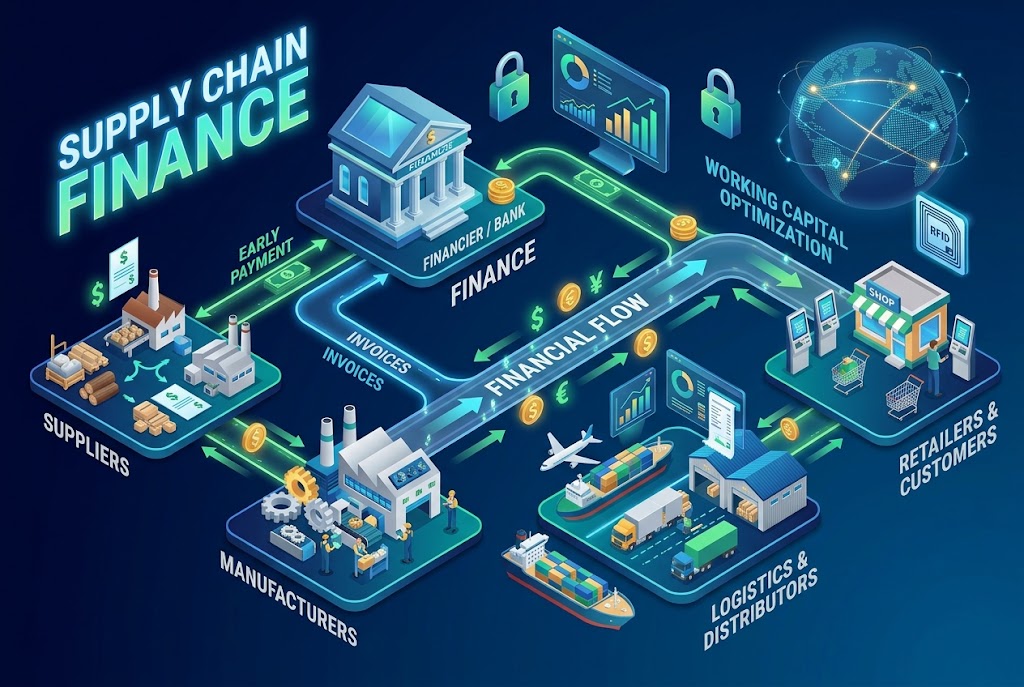
This topic introduces the financial principles underpinning supply chain activities. Learners explore how money moves between buyers, suppliers, manufacturers and distributors, and how financial arrangements influence the availability of goods and services. It establishes the foundation for understanding how finance supports the entire supply chain, from purchasing raw materials to delivering products to customers.
Corporate finance examines how organisations make financial decisions concerning investment, funding and the allocation of resources. Learners explore how these principles apply to supply chain operations, including decisions about equipment, warehousing, transportation and supplier relationships. The objective is to understand how financial choices can support profitability, business growth and long-term organisational performance.
This topic examines how supply chain decisions affect an organisation's financial results. Learners consider the relationship between operational efficiency, purchasing costs, inventory levels, delivery performance and profitability. Understanding these connections helps professionals assess the financial consequences of supply chain decisions and identify opportunities to improve business performance.
Working capital management focuses on the money required to keep a business operating effectively. Learners examine the relationship between inventory, accounts receivable and accounts payable, considering how organisations maintain liquidity while meeting operational commitments. This knowledge is particularly useful for businesses that must pay suppliers, manage stock and wait for customers to settle invoices.
This topic builds on working capital management by exploring ways to use available financial resources more efficiently. Learners consider how organisations can improve cash flow, reduce unnecessary inventory holdings and manage payment cycles. The practical objective is to help businesses maintain operational stability while releasing funds that can be used for investment, growth or other priorities.
Learners are introduced to financial instruments and arrangements that can support transactions between businesses in a supply chain. These may include financing mechanisms designed to help suppliers receive payment, enable buyers to manage payment timing or support international trade. Understanding these arrangements helps professionals appreciate how financial tools can improve liquidity and support commercial relationships.
This topic connects financial theory with practical supply chain situations. Learners consider how organisations use financial strategies to address operational challenges, manage supplier relationships and improve the movement of money through their supply networks. It helps bridge the gap between understanding financial concepts and applying them to real business decisions.
International supply chains face additional financial challenges, including cross-border payments, currency fluctuations, differing commercial practices and uncertainty in global markets. This topic explores the financial considerations associated with operating across national boundaries. It is particularly relevant to professionals working in international procurement, import and export, shipping, distribution and multinational business operations.
Sustainability is increasingly influencing how organisations select suppliers, invest in operations and evaluate long-term business risks. Learners examine how environmental and sustainability considerations can affect supply chain financial decisions. This understanding helps professionals recognise that responsible sourcing and sustainable operations can have implications for costs, investment decisions, resilience and long-term value.
Economics for business introduces the economic principles that influence organisational decisions and market behaviour. Learners explore how factors such as supply and demand, costs, competition and broader economic conditions affect business operations. This knowledge can help supply chain professionals understand changing market conditions and make better-informed financial and commercial decisions.
Transaction cost economics examines the costs associated with conducting business, including finding suppliers, negotiating contracts, monitoring performance and managing commercial relationships. Learners consider how organisations decide whether to outsource activities, work with external suppliers or manage functions internally. The topic supports more informed decisions about supplier selection, contracting and supply chain structure.
Management accounting focuses on the financial information managers use to plan, monitor and control business operations. In a supply chain context, learners explore how costing, budgeting and performance information can support decisions about procurement, inventory, logistics and resource allocation. These skills can help managers identify inefficiencies, monitor expenditure and align operational activities with financial objectives.
Related Courses
Leadership in Practice (Short Course)
Qualification: Micro-Credentials / Short Courses
Duration: 13 weeks
Tuition: £1,543
View ProgrammeEconomics for Managers (Short Course)
Qualification: Micro-Credentials / Short Courses
Duration: 13 weeks
Tuition: £1,543
View ProgrammeDiversity Management in a Global Economy (Short Course)
Qualification: Micro-Credentials / Short Courses
Duration: 13 weeks
Tuition: £1,543
View ProgrammeApply for This Programme
You need an UpCaria account before starting your application. Log in to your existing account or create a new one.
🎓 Scholarship Eligibility Checker
Select your country to check whether you may qualify for a scholarship for this programme.

