

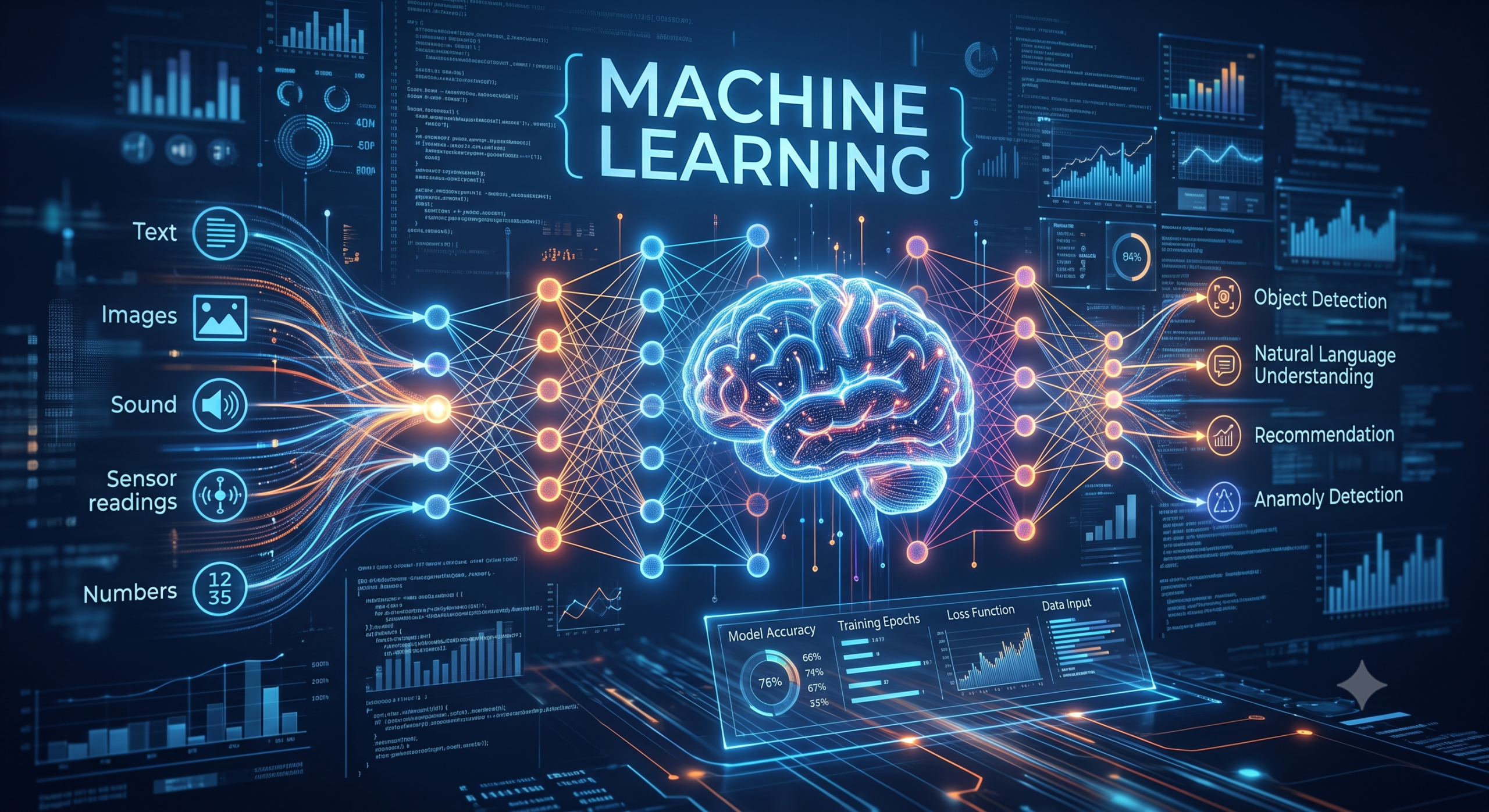
Machine Learning
Validated by University of Essex Online
Duration
13 weeksStudy Mode
OnlineTotal Tuition
£1,492Monthly Payment
£485Qualification
Micro-Credentials / Short CoursesStart Date
July, OctoberProgramme Overview
The Machine Learning online professional course from the University of Essex Online is designed to provide learners with practical knowledge of one of today's fastest-growing areas of technology. Over 13 weeks, students develop an understanding of how intelligent systems learn from data, explore industry-standard machine learning algorithms, and gain hands-on experience designing machine learning solutions for real-world business challenges. The course combines theoretical foundations with practical applications, making it ideal for professionals who want to develop skills in artificial intelligence, data analytics, automation, and predictive modelling. For Caribbean professionals and graduates, this course offers an excellent opportunity to build globally relevant digital skills that can be applied across sectors such as banking, healthcare, tourism, government, telecommunications, agriculture, cybersecurity, and fintech.
Entry Requirements
Applicants are expected to meet the following requirements:
No formal academic qualifications or previous machine learning experience are required.
The course is suitable for beginners as well as professionals wishing to upskill.
Students must have a good command of the English language.
Applicants whose first language is not English should demonstrate English proficiency equivalent to IELTS Academic 6.5, although the University also provides a free online English assessment.
Who is this course for?
This professional course is ideal for:
IT professionals seeking to expand into Artificial Intelligence
Software Developers
Data Analysts
Data Scientists
Business Intelligence Professionals
Engineers
Cybersecurity Professionals
Digital Transformation Leaders
Recent university graduates interested in AI
Caribbean professionals working in banking, insurance, healthcare, logistics, tourism, agriculture, education, and government who want to leverage machine learning for smarter decision-making and innovation.
Career Opportunities
Machine Learning Engineer
Artificial Intelligence Engineer
Data Scientist
Data Analyst
Business Intelligence Analyst
AI Solutions Consultant
Predictive Analytics Specialist
Computer Vision Engineer
Natural Language Processing (NLP) Specialist
Research and Development Engineer (Artificial Intelligence)
Programme Highlights
Students begin by exploring the principles that underpin machine learning, including the different types of learning, model bias and variance, ethical considerations, confidentiality, and responsible AI practices. This foundation helps learners understand how machines identify patterns, make predictions, and improve performance through experience. Special attention is given to ethical AI, an increasingly important topic as Caribbean governments and businesses adopt data-driven technologies.
This section introduces algorithms that discover hidden patterns in data without predefined labels. Students learn how clustering techniques group similar observations and how these methods support customer segmentation, fraud detection, market analysis, tourism planning, and healthcare analytics. Learners also understand when unsupervised learning is more appropriate than traditional statistical approaches.
One of the most practical areas of the programme focuses on supervised learning techniques. Students study decision trees, Random Forest algorithms, linear regression, and classification models that enable computers to make predictions from historical data. These techniques are widely used in financial forecasting, credit scoring, disease prediction, customer behaviour analysis, insurance risk assessment, and predictive maintenance. Throughout the module, learners develop an understanding of selecting appropriate algorithms for different business problems.
Students explore more advanced machine learning approaches, including reinforcement learning, artificial neural networks, and deep learning. These technologies power autonomous systems, intelligent recommendation engines, speech recognition, computer vision, robotics, and generative AI applications. The module demonstrates how modern AI systems continuously improve their decision-making capabilities through learning from interactions and large datasets.
Building accurate machine learning models requires careful testing and optimisation. In this topic, students learn techniques such as bootstrapping and other evaluation methods used to measure model performance, minimise errors, and improve predictive accuracy. Learners gain valuable experience selecting appropriate performance metrics and refining models before deployment in real-world environments.
Related Courses
Advanced Diploma in Information Technology
Qualification: Professional Diploma
Duration: 12 months
Tuition: €4,000
View ProgrammeBachelor of Science in Business Information Technology (IT)
Qualification: Bachelor’s Degree
Duration: 3 Years
Tuition: €12,000
View ProgrammeBachelor of Science (BSc) in Artificial Intelligence
Qualification: Bachelor’s Degree
Duration: 3 years
Tuition: €10,500
View ProgrammeApply for This Programme
You need an UpCaria account before starting your application. Log in to your existing account or create a new one.
🎓 Scholarship Eligibility Checker
Select your country to check whether you may qualify for a scholarship for this programme.