

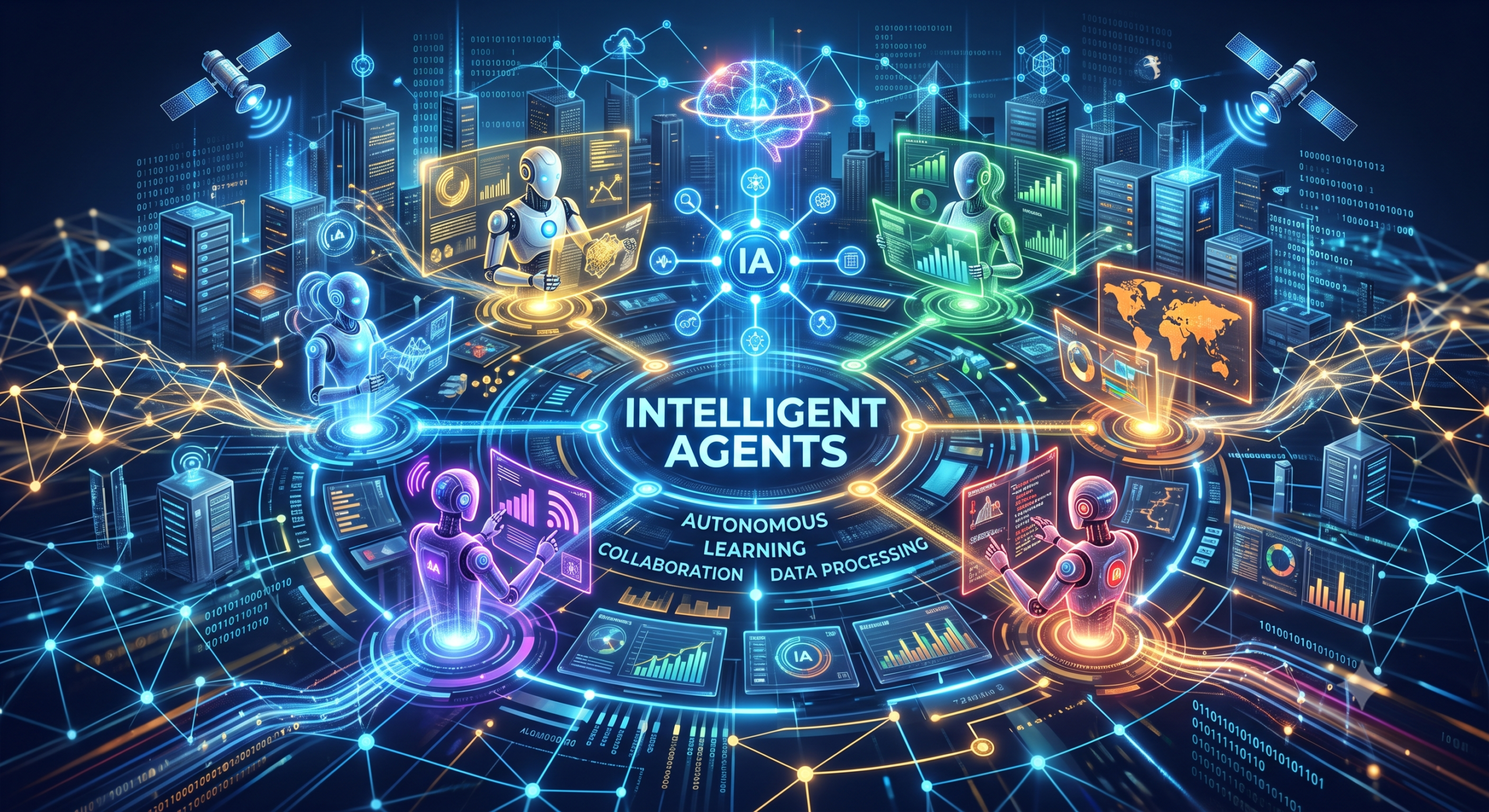
Intelligent Agents
Validated by University of Essex Online
Duration
13 weeksStudy Mode
OnlineTotal Tuition
£1,543Monthly Payment
£515Qualification
Micro-Credentials / Short CoursesStart Date
July, OctoberProgramme Overview
The Intelligent Agents online professional course from the University of Essex Online is a postgraduate-level, 20-credit programme designed to introduce students to one of the fastest-growing areas of Artificial Intelligence (AI). Over 13 weeks of flexible online study, learners gain practical knowledge of intelligent software agents that can perceive environments, make autonomous decisions, solve complex problems, and interact with other systems and users. The course explores how intelligent agents are transforming industries such as financial services, healthcare, cybersecurity, manufacturing, logistics, and smart cities. For Caribbean professionals and graduates seeking to future-proof their careers, this course provides an excellent introduction to AI technologies that are increasingly being adopted across government, tourism, banking, telecommunications, agriculture, and emerging digital economies throughout the region.
Entry Requirements
Unlike many postgraduate AI programmes, this professional course has highly accessible entry requirements.
Applicants should have:
No formal academic qualifications or previous computing experience are required.
A good standard of English.
If English is not the applicant's first language, English proficiency equivalent to IELTS 6.5 is recommended.
Applicants without an IELTS certificate may complete the University's free online English assessment.
This makes the programme particularly attractive to Caribbean professionals looking to transition into AI regardless of their previous academic discipline.
Who is this course for?
This programme is ideal for:
IT professionals seeking AI specialization
Software developers
Data analysts
Computer science graduates
Engineers
Financial technology (FinTech) professionals
Digital transformation managers
Government ICT professionals
Business analysts
Entrepreneurs interested in AI-driven innovation
Caribbean professionals seeking international AI credentials
Individuals planning to progress to a PG Diploma or MSc in Artificial Intelligence
Career Opportunities
Artificial Intelligence Specialist
Intelligent Systems Developer
Machine Learning Engineer
AI Solutions Consultant
Robotics Software Developer
Business Intelligence Analyst
Natural Language Processing Engineer
FinTech Solutions Developer
Automation Systems Engineer
AI Research and Innovation Specialist
Programme Highlights
Students begin by learning what intelligent agents are, how they differ from traditional software, and why they are fundamental to modern Artificial Intelligence. The course explores autonomous systems capable of perceiving their environments, making decisions, and performing tasks without continuous human intervention. Learners examine practical applications including virtual assistants, recommendation engines, robotics, smart transportation, healthcare systems, and business automation. Caribbean students gain valuable insight into how intelligent agents can support regional digital transformation initiatives and improve public and private sector efficiency.
This section explores how intelligent agents are designed and structured. Students learn about different agent architectures, including reactive, deliberative, hybrid, and learning-based agents. They also examine multi-agent systems where numerous intelligent agents cooperate or compete to solve complex problems. These concepts are increasingly important in smart cities, logistics management, distributed computing, autonomous transportation, disaster response, and intelligent business operations—all highly relevant to developing Caribbean economies seeking scalable digital solutions.
Learners study how intelligent agents communicate, negotiate, coordinate, and compete while solving real-world challenges. The course examines collaborative decision-making, distributed problem solving, game theory principles, negotiation strategies, and conflict resolution between autonomous systems. Students discover how these techniques power applications such as automated trading, supply chain optimization, cybersecurity defence systems, autonomous drones, and intelligent traffic management. These skills are increasingly valuable for organizations adopting AI-enabled decision support systems.
This topic introduces one of AI's most exciting disciplines—Natural Language Processing. Students learn how computers interpret, analyse, and generate human language. They also study sentiment analysis, enabling AI systems to identify opinions, emotions, and customer attitudes from text and speech. Applications include AI chatbots, customer service automation, social media monitoring, fraud detection, healthcare communication, and tourism customer experience analysis. Caribbean businesses increasingly use these technologies to improve customer engagement across hospitality, financial services, telecommunications, and government services.
Students are introduced to adaptive algorithms that enable intelligent systems to improve their performance over time through learning. The course explains the foundations of artificial neural networks and demonstrates how machines identify patterns, classify information, and make predictions from large datasets. Learners gain an understanding of the principles behind modern AI technologies such as image recognition, speech recognition, fraud detection, predictive analytics, recommendation systems, and autonomous decision-making. These capabilities are becoming essential across Caribbean banking, insurance, healthcare, agriculture, and national security sectors.
Related Courses
Advanced Diploma in Information Technology
Qualification: Professional Diploma
Duration: 12 months
Tuition: €4,000
View ProgrammeBachelor of Science in Business Information Technology (IT)
Qualification: Bachelor’s Degree
Duration: 3 Years
Tuition: €12,000
View ProgrammeBachelor of Science (BSc) in Artificial Intelligence
Qualification: Bachelor’s Degree
Duration: 3 years
Tuition: €10,500
View ProgrammeApply for This Programme
You need an UpCaria account before starting your application. Log in to your existing account or create a new one.
🎓 Scholarship Eligibility Checker
Select your country to check whether you may qualify for a scholarship for this programme.