

Disaster Management and Resilience (MSc)
Validated by Coventry University
Duration
2 years part-timeStudy Mode
OnlineTotal Tuition
£10,440Monthly Payment
£435Qualification
Master’s Degree (MSc / MA / MPH)Start Date
Jan, May, SepProgramme Overview
The MSc Disaster Management and Resilience from Coventry University Online is a 100% online postgraduate degree designed for professionals seeking advanced knowledge and practical capability in disaster risk reduction, emergency management, humanitarian action, resilience, recovery and reconstruction. The programme is delivered part-time over two years, allowing students to continue working while completing their master's degree. It is particularly relevant to professionals working in government disaster-management agencies, NGOs, civil-society organisations, humanitarian organisations and related public- and private-sector environments.
The programme takes a multidisciplinary approach to the increasingly complex risks facing communities, organisations and countries. Students examine disaster risk, resilience, sustainability, humanitarian response, critical-incident leadership, community preparedness, strategic foresight, recovery and reconstruction, while developing the ability to assess complex situations and make informed decisions. Coventry states that the programme is designed around practical content and industry-focused learning, with opportunities to apply learning to real-world disaster and resilience challenges.
A particularly useful feature for an international audience is the programme's global applicability. Disaster and climate-related risks, pandemics, infrastructure disruption, humanitarian crises, technological dependence, economic instability and severe weather affect countries across regions, creating demand for professionals capable of planning, coordinating and strengthening resilience. Students complete an independent research project in an area such as disaster management, emergency management, resilience, public safety, international development or sustainability
Entry Requirements
Standard academic requirement
Applicants should normally have:
A 2:2 undergraduate degree or equivalent
The degree should normally be in a relevant discipline
Applicants with a lower classification may be considered individually.
Applicants without the standard degree profile but with relevant professional experience may also be individually considered and may normally be interviewed.
English-language requirement
Coventry currently lists:
IELTS 6.5 overall
Minimum 5.5 in each component
Applicants who do not meet the requirement may be able to complete an approved pre-sessional English programme. Country-specific requirements also apply.
Documents applicants should be prepared to provide
For worldwide marketing, applicants should generally be prepared to provide:
Completed online application
Bachelor's degree certificate
Official academic transcripts
Evidence of relevant professional experience, where applicable
CV/resume, particularly where professional experience is being considered
Identification/passport documentation
English-language evidence where applicable
Any additional country-specific documentation requested by Coventry University
Coventry specifically states that applicants will need documentation relating to their previous qualifications and experience, while exact requirements can vary by country.
Who is this course for?
The MSc Disaster Management and Resilience is designed for professionals and graduates who want to develop advanced knowledge and practical skills in disaster risk reduction, emergency planning, humanitarian response, and building resilient communities. The programme is particularly suited for individuals working in government agencies, non-governmental organisations (NGOs), international development organisations, emergency services, civil society, and organisations responsible for managing risks associated with natural disasters, climate change, conflicts, and humanitarian crises. It is also suitable for professionals seeking to transition into disaster management careers by gaining expertise in risk assessment, resilience planning, crisis response, and recovery strategies.
This degree is ideal for:
Professionals working in:
Disaster management agencies
Emergency planning and response organisations
Government ministries and public sector agencies
NGOs and humanitarian organisations
Community development and resilience programmes
Individuals interested in:
Disaster risk reduction and prevention
Climate change adaptation and resilience
Humanitarian action and crisis management
Emergency preparedness and recovery planning
Graduates from backgrounds such as:
Environmental studies
Geography
International development
Public policy
Health and safety
Engineering
Social sciences
Business and management
Professionals seeking leadership roles in disaster preparedness, crisis response, and resilience planning.
Career Opportunities
Disaster Management Specialist
Emergency Management Officer
Humanitarian Programme Manager
Disaster Risk Reduction Advisor
Crisis Management Consultant
Climate Resilience Specialist
Business Continuity Manager
Emergency Planning Consultant
Risk and Resilience Analyst
Government Disaster Preparedness Officer
Programme Highlights
This module establishes the conceptual foundation of disaster risk reduction by examining the relationships between risk, resilience, adaptation, development and sustainability. Students explore historical and contemporary international events, policy drivers and the disaster-development continuum while critically examining the work of NGOs, multilateral agencies and institutions. For students, this is particularly valuable for understanding how disaster-risk reduction can be integrated into national development, climate adaptation and sustainable-development strategies.
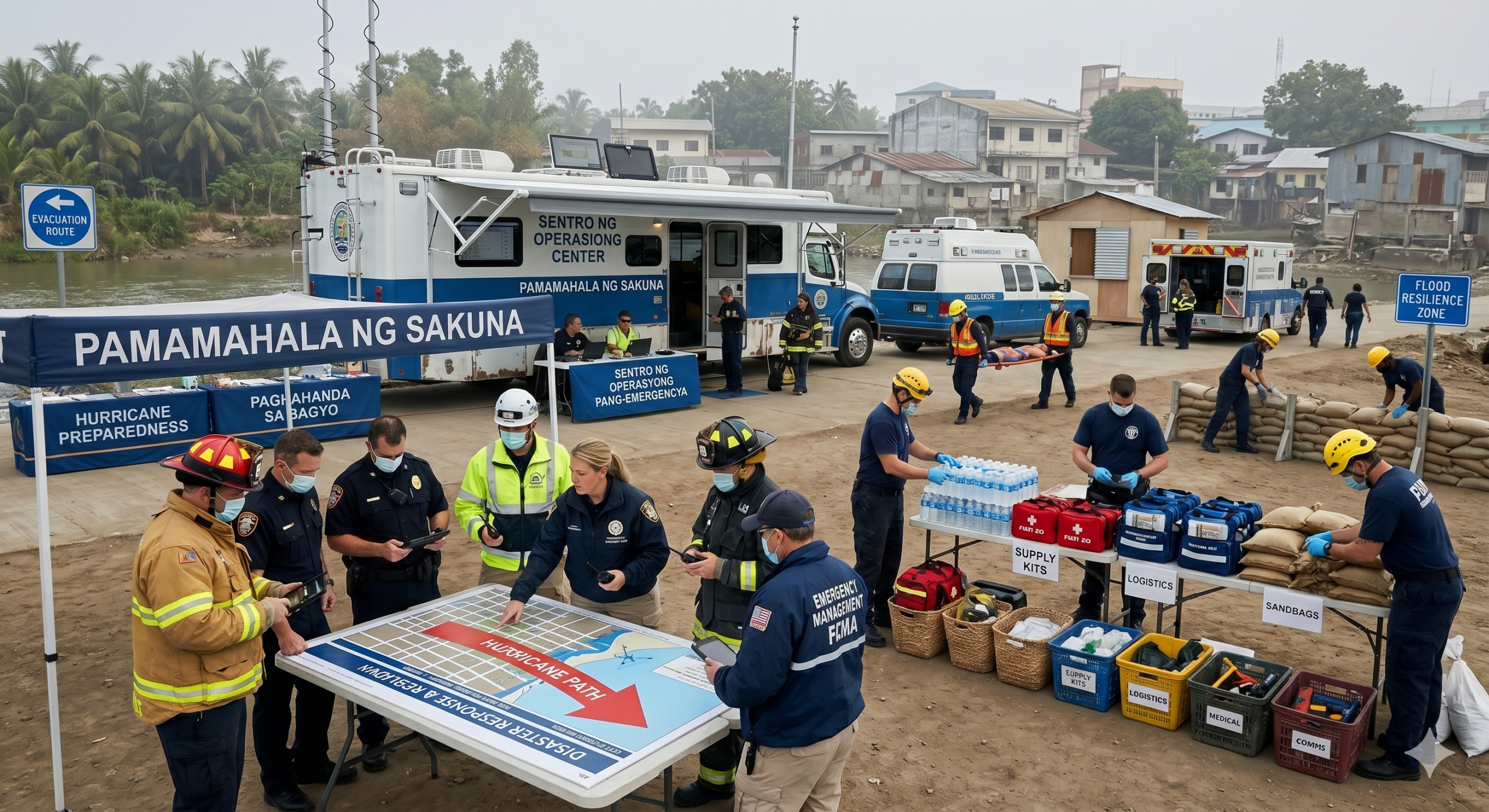
This module focuses on the practical design, planning and management of disaster, crisis and emergency-management exercises. Students learn how training and simulation activities contribute to organisational preparedness and resilience, while developing approaches for evaluating exercises and capturing lessons learned. This has direct relevance to emergency-management agencies that conduct hurricane, earthquake, tsunami, mass-casualty, evacuation and other emergency-response exercises.
Students examine how organisations can plan strategically in environments characterised by uncertainty, rapid change and interconnected risks. The module introduces systems thinking, strategic thinking and approaches to anticipating future trends and developing long-term strategies. For governments and organisations, this provides a useful framework for moving beyond reactive disaster response toward anticipatory planning and long-term resilience
This module examines what makes communities resilient before, during and after disasters. Students assess the relationship between resilience, preparedness and recovery, analyse international case studies and consider how professionals, public-sector agencies, NGOs and community organisations can work together. The module is particularly relevant to communities where local capacity, social networks, community engagement and public preparedness can significantly influence disaster outcomes.
Students develop an understanding of contemporary humanitarian principles, disaster preparedness and humanitarian response. The module examines the organisational architecture, standards and drivers that shape humanitarian operations, together with current challenges facing organisations responding to disasters. This is highly relevant to professionals working with government agencies, NGOs, regional bodies and international humanitarian organisations following major disasters.
This module develops skills in MEAL, Monitoring, Evaluation, Accountability and Learning, and examines how effective governance and evidence-based evaluation can improve disaster interventions. Students analyse disaster-response and disaster-risk-reduction case studies and explore how organisations can use evidence and shared learning to improve programme impact, accountability, resilience and sustainability. These capabilities are valuable for Caribbean organisations managing donor-funded disaster, climate adaptation and humanitarian programmes.
Critical Incident Leadership develops the leadership and decision-making capabilities required during emergencies and crises. Students explore risk interpretation, non-technical skills, leadership models and decision-making within command-and-control environments, while examining how organisations can learn from incidents and overcome barriers to implementing change. This module is particularly applicable to emergency managers, public-sector leaders, security professionals and other personnel responsible for coordinating multi-agency responses.
This module focuses on the complex period following a disaster, including recovery, reconstruction and the transition toward long-term development. Students examine international case studies, recovery standards, minimum requirements and lessons from previous reconstruction efforts, while considering how recovery can support sustainability and future disaster-risk reduction. For Caribbean countries repeatedly affected by hurricanes and other hazards, this provides valuable expertise for building back more resilient communities, infrastructure and economies.
The research project is the largest component of the programme and gives students the opportunity to investigate a specialist issue in disaster management, emergency management, resilience, public safety, international development or sustainability. Students develop skills in problem identification, literature review, research design, methodology, data collection, analysis and professional report writing under academic supervision. For students, this creates an excellent opportunity to research a real regional issue, such as hurricane preparedness, coastal resilience, climate migration, disaster financing, emergency communications, resilient healthcare or community disaster preparedness, and produce evidence-based recommendations.
This module develops leadership capabilities for managing diverse and inclusive teams. Students examine leadership theory, organisational culture, wellbeing, equality, diversity and inclusion, while reflecting on their own professional development and leadership practice. In disaster management, where effective response depends on coordination among government agencies, emergency services, NGOs, volunteers, communities and international partners, the ability to lead diverse teams is an important professional competency.
Related Courses
Disaster Management and Resilience (PGCert)
Qualification: Postgraduate Certificate
Duration: 1 year
Tuition: £3,480
View ProgrammeEmergency Preparedness and Management (PGCert)
Qualification: Postgraduate Certificate
Duration: 1 year
Tuition: £3,480
View ProgrammeCrisis and Organisational Resilience (PGCert)
Qualification: Postgraduate Certificate
Duration: 1 year
Tuition: £3,480
View ProgrammeDisaster Management and Resilience (PGCert)
Validated by Coventry University
Duration
1 yearStudy Mode
OnlineTotal Tuition
£3,480Monthly Payment
£290Qualification
Postgraduate CertificateStart Date
January May SeptemberProgramme Overview
Programme Overview
The Postgraduate Certificate in Disaster Management and Resilience (PGCert) is a 100% online postgraduate qualification from Coventry University designed for professionals seeking to develop advanced knowledge and practical skills in disaster management, humanitarian action, disaster risk reduction and resilience. The programme focuses on how organisations, governments, communities and humanitarian agencies can anticipate, prepare for, respond to and recover from increasingly complex disasters and crises. Students examine contemporary risks including climate change, severe weather, pandemics, technological dependence, economic instability, social inequalities and other interconnected threats. The programme is particularly relevant for professionals working in government disaster-management agencies, NGOs, civil society organisations and related emergency, humanitarian and resilience fields.
The programme is delivered 100% online, allowing working professionals to study without relocating or leaving employment. It is a 60-credit PGCert normally completed part-time over two years, with one 15-credit module typically studied per semester. Students receive access to online learning resources, tutors, live sessions that are recorded for later viewing, academic support, career support and electronic library resources. Coventry University states that the qualification is awarded by Coventry University as part of the Coventry University Group. The university's programme information does not currently list a separate professional-body accreditation specific to this PGCert; therefore, UpCaria marketing should describe it as a Coventry University postgraduate qualification rather than claiming a separate professional accreditation.
The PGCert is particularly attractive to professionals who want to strengthen their credentials without committing immediately to a full master's degree. It can provide a pathway toward further postgraduate study, including progression to a master's in Disaster Management and Resilience. Students develop competencies in risk assessment, disaster planning, humanitarian response, community resilience, stakeholder engagement, governance, monitoring and evaluation, accountability, learning and strategic decision-making. These skills have applications across government, international development, humanitarian organisations, health services, military and security environments, insurance, risk management, resilience consulting and emergency planning.
Entry Requirements
Standard academic requirement
Applicants should normally have:
A 2:2 undergraduate degree or equivalent in a relevant discipline.
Applicants with a lower classification and/or relevant professional experience only may be individually considered.
Applicants in these circumstances will usually be interviewed before an offer is made.
Coventry also provides country-specific international entry requirements.
English-language requirement
The published requirement is:
IELTS 6.5 overall
Minimum 5.5 in each component
Applicants who do not meet the required level may be able to meet the requirement through an approved pre-sessional English programme.
Documents applicants should prepare
For UpCaria recruitment purposes, applicants should be prepared to provide:
Degree certificate(s)
Academic transcripts
Evidence of relevant professional experience, where applicable
English-language evidence, where required
Identification/passport documentation as required during the application process
Any additional documents requested following assessment of the applicant's country, academic background or professional experience.
Coventry specifically confirms that applicants will need documentation relating to their previous qualifications and experience when applying.
Who is this course for?
The PGCert is particularly suitable for:
Disaster management professionals
Emergency management professionals
Humanitarian workers
Government disaster-management officers
Civil protection professionals
NGO and civil-society professionals
Emergency planning personnel
Risk-management professionals
Public-sector managers
Health and epidemiology professionals
Military and security personnel
Professionals working in climate resilience
Insurance and risk professionals
Individuals seeking to enter disaster management and humanitarian action
Career Opportunities
Disaster Management Officer / Manager
Emergency Preparedness and Planning Officer
Humanitarian Programme Officer / Manager
Disaster Risk Reduction Specialist
Community Resilience Specialist
Emergency Management Consultant
Risk and Resilience Consultant
Humanitarian Monitoring & Evaluation Specialist
Civil Protection / Government Emergency Management Officer
Disaster & Crisis Management Programme Manager
Programme Highlights
This module examines the relationship between disaster risk, resilience, adaptation, development and sustainability. Students explore historical and contemporary international disasters, policy drivers and the disaster-development continuum. Particular attention is given to the work of NGOs, multilateral organisations and other institutions involved in disaster risk reduction and humanitarian practice. The module helps students understand how sustainable development, resilience, disaster-risk reduction and humanitarian action are interconnected.
This module focuses on the principles, theories and management approaches underpinning humanitarian action and disaster response. Students examine humanitarian preparedness and response, organisational structures, international standards, operational drivers and the changing challenges faced by humanitarian organisations. It is particularly relevant for professionals who may work with NGOs, international agencies, government authorities or other organisations responding to humanitarian crises.
This module explores how communities can prepare for, withstand and recover from disasters and other disruptive events. Students examine different interpretations of resilience and assess the factors that influence community preparedness and recovery. International and UK case studies are used to explore community engagement, the role of professionals, public-service providers and NGOs, and methods for evaluating whether resilience interventions are effective and sustainable.
This module develops students' understanding of MEAL — Monitoring, Evaluation, Accountability and Learning — within disaster management and humanitarian programmes. Students explore how governance, international policy and local projects interact and examine traditional and emerging approaches to evaluating disaster interventions. The module emphasises how systematic monitoring, accountability, evaluation and organisational learning can improve disaster-response outcomes, strengthen resilience and support more sustainable interventions.
Related Courses
Emergency Preparedness and Management (PGCert)
Qualification: Postgraduate Certificate
Duration: 1 year
Tuition: £3,480
View ProgrammeCrisis and Organisational Resilience (PGCert)
Qualification: Postgraduate Certificate
Duration: 1 year
Tuition: £3,480
View ProgrammeEmergency and Incident Management (PGCert)
Qualification: Postgraduate Certificate
Duration: 1 year
Tuition: £3,480
View ProgrammeApply for This Programme
You need an UpCaria account before starting your application. Log in to your existing account or create a new one.
🎓 Scholarship Eligibility Checker
Select your country to check whether you may qualify for a scholarship for this programme.

