

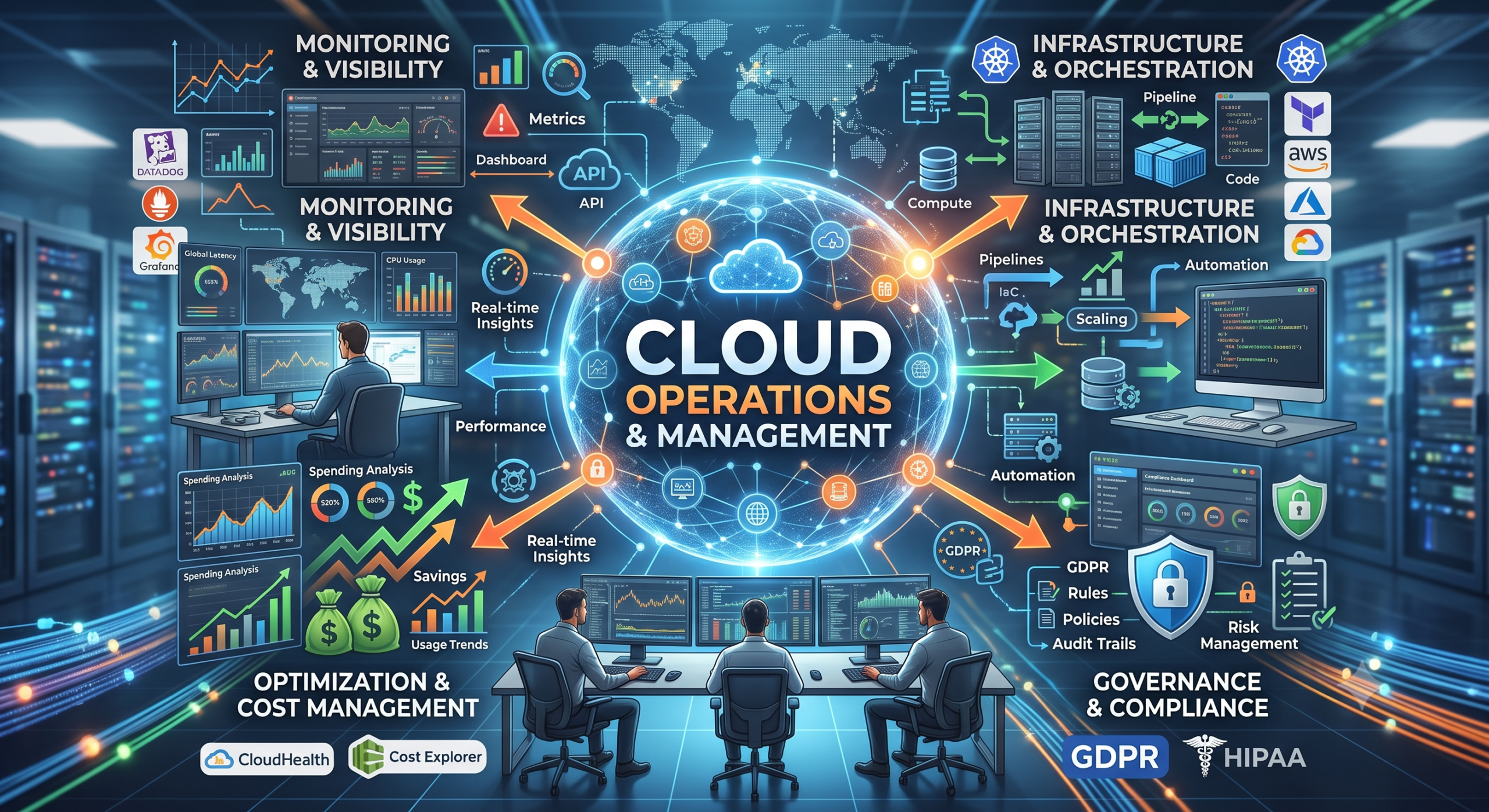
Cloud Operations and Management
Validated by University of Essex Online
Duration
13 weeksStudy Mode
OnlineTotal Tuition
£1,543Monthly Payment
£585Qualification
Micro-Credentials / Short CoursesStart Date
July, OctoberProgramme Overview
The Cloud Operations and Management online professional course from the University of Essex Online is designed to equip learners with practical knowledge of modern cloud computing technologies and the operational skills needed to manage cloud-based environments. Delivered 100% online over 13 weeks, the programme explores cloud infrastructure, architecture, deployment models, cloud-native technologies, hybrid cloud environments, and emerging trends such as edge and fog computing. Students also examine the standards, governance, and operational practices that support secure, scalable, and efficient cloud services. Successful completion awards 20 postgraduate academic credits, which can be transferred toward selected postgraduate qualifications. For professionals across the Caribbean, where governments, banks, healthcare providers, educational institutions, tourism businesses, and telecommunications companies are rapidly adopting cloud technologies, this programme provides valuable skills for digital transformation and career advancement.
Entry Requirements
Applicants do not need previous qualifications or professional experience to enrol.
Applicants should have:
No formal academic qualifications are required.
A good command of English.
If English is not your first language, proficiency should be equivalent to IELTS Academic 6.5.
Applicants without an IELTS qualification can complete the University's free online English assessment.
Who is this course for?
IT support professionals seeking cloud computing skills
Systems and network administrators
Software developers interested in cloud deployment
Business technology managers
Cybersecurity professionals
Database administrators
Telecommunications professionals
Digital transformation specialists
Recent graduates pursuing careers in cloud computing
Caribbean professionals looking to upskill for regional and international technology opportunities
Career Opportunities
Cloud Operations Specialist
Cloud Administrator
Cloud Solutions Architect (entry pathway)
Cloud Infrastructure Engineer
Systems Administrator
DevOps Engineer
IT Operations Manager
Cloud Support Engineer
Technical Consultant (Cloud Technologies)
Digital Transformation Consultant
Programme Highlights
Students begin by developing a solid understanding of cloud computing principles, including the various cloud service models (IaaS, PaaS and SaaS), deployment options, virtualization, scalability, and the economic advantages of cloud adoption. This module provides the essential foundation for understanding how organizations leverage cloud technologies to improve operational efficiency and support digital innovation across industries
This module explores how cloud infrastructures are designed, built, and managed. Students examine distributed computing, virtualization technologies, cloud frameworks, storage architectures, networking, and service integration. By understanding cloud architecture, learners develop the ability to evaluate and recommend cloud solutions that align with business objectives while ensuring reliability, performance, and security.
Students gain exposure to tools used to design, configure, and deploy cloud environments. The module introduces scripting techniques, graphical user interface (GUI) development, automation concepts, and cloud-based data analysis tools. Learners discover how these technologies simplify cloud operations, improve productivity, and enable organizations to automate routine processes while reducing operational c
Cloud-native applications have transformed how modern software is developed and deployed. This module introduces containerization, microservices, orchestration, scalability, and continuous deployment principles that support resilient cloud applications. Students learn why cloud-native technologies have become the preferred approach for organizations seeking greater flexibility, faster innovation, and improved system performance.
Organizations increasingly combine private and public cloud platforms to maximize flexibility and security. This module examines hybrid cloud strategies alongside emerging technologies such as edge computing and fog computing. Students learn how hybrid environments improve business continuity, regulatory compliance, operational efficiency, and digital resilience while supporting increasingly distributed workforces and connected devices.
Related Courses
Advanced Diploma in Information Technology
Qualification: Professional Diploma
Duration: 12 months
Tuition: €4,000
View ProgrammeBachelor of Science in Business Information Technology (IT)
Qualification: Bachelor’s Degree
Duration: 3 Years
Tuition: €12,000
View ProgrammeBachelor of Science (BSc) in Artificial Intelligence
Qualification: Bachelor’s Degree
Duration: 3 years
Tuition: €10,500
View ProgrammeApply for This Programme
You need an UpCaria account before starting your application. Log in to your existing account or create a new one.
🎓 Scholarship Eligibility Checker
Select your country to check whether you may qualify for a scholarship for this programme.