

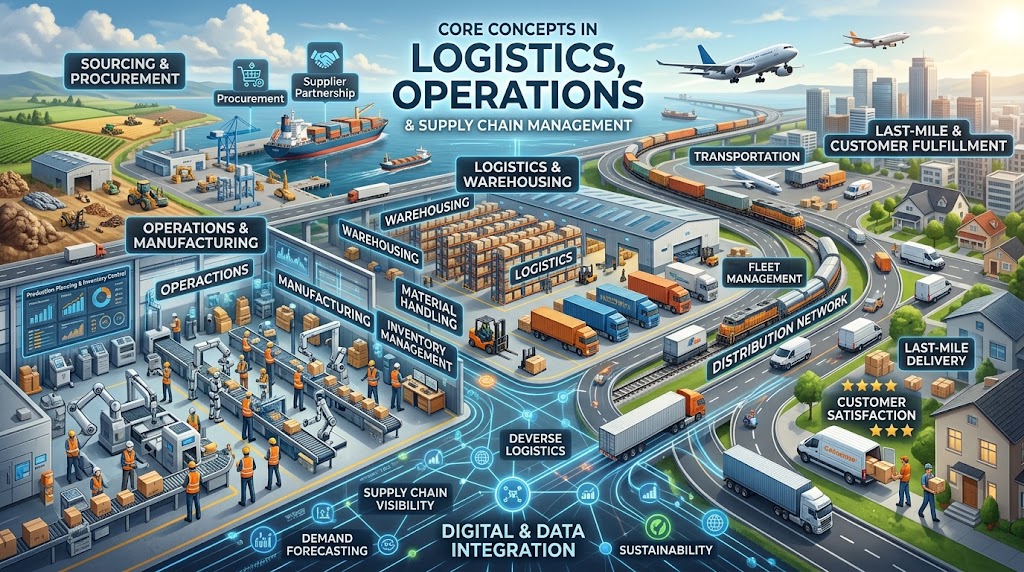
Core Concepts in Logistics, Operations and Supply Chain Management (Short Course)
Validated by University of Essex Online
Duration
13 weeksStudy Mode
OnlineTotal Tuition
£1,543Monthly Payment
One-time paymentQualification
Micro-Credentials / Short CoursesStart Date
January April July SeptemberProgramme Overview
University of Essex Online | 13-Week Postgraduate-Level Professional Course | 20 Credits | CPD Certified
Marketed worldwide through UpCaria Education Gateway, a StratPro Education International Services LLC platform.
Programme Overview
The Core Concepts in Logistics, Operations and Supply Chain Management course is a 13-week, postgraduate-level online professional course awarded by the University of Essex through Essex Online. The course is designed to develop a practical understanding of how logistics, operations, procurement, manufacturing, distribution and supply chain management work together to support organisational performance. Students explore the principles governing the movement of goods and services, the coordination of international supply networks, the management of production and logistics functions, and the strategic decisions that influence operational efficiency. The programme also examines sustainability, ethical business practices and the challenges associated with managing increasingly complex global supply chains. Worth 20 postgraduate-level academic credits, the course provides a focused professional development opportunity for individuals who want to strengthen their business knowledge without committing to a full postgraduate degree.
The course is delivered 100% online and part-time, making it suitable for working professionals, business owners and individuals seeking to develop their expertise while maintaining their employment. Learning takes place through an online virtual learning environment featuring multimedia lecturecasts, videos, reading materials, discussion forums, mini-assignments and live question-and-answer sessions with tutors. Assessment is assignment-based, including written assignments, assessed discussion forums and journal entries. The course is accredited by The CPD Certification Service, providing a formal record of continuing professional development that can be included in an individual's professional development portfolio. Successful students receive a University of Essex Online professional course certificate, a transcript and recognition of the 20 postgraduate-level credits earned. The course also offers a potential progression route into further postgraduate study in supply chain management and global logistics, subject to the university's applicable progression arrangements.
Through UpCaria Education Gateway, this course can be marketed to professionals and organisations worldwide seeking accessible, internationally oriented professional education. It is particularly relevant to employees in manufacturing, retail, wholesale distribution, shipping, transportation, import and export, procurement, warehousing, government operations and logistics services. Participants will develop a stronger understanding of supply chain processes, operational coordination, quality management, international trade and sustainability, helping them make more informed decisions in their current roles and prepare for expanded responsibilities. The course requires no formal academic qualifications or previous work experience, making it accessible to individuals entering the field as well as experienced professionals seeking structured development. With an international tuition fee of £1,543 for the 2026–2027 academic year, a 13-week duration and a recognised CPD framework, the course offers a targeted opportunity to acquire postgraduate-level knowledge without the time commitment or tuition expense of a full master's degree.
Entry Requirements
Entry Requirements and Documents
Academic entry requirements
One of the programme's key advantages is its accessible admission policy.
No formal academic qualifications are required.
No previous employment or industry experience is required.
Applicants should demonstrate sufficient English proficiency to participate in postgraduate-level online learning.
Applicants whose first language is not English may need English proficiency equivalent to IELTS Academic 6.5.
Applicants who qualify for the university's English-language exemptions may not need to submit separate English proficiency evidence.
The university also indicates that a free online English test may be available for applicants who do not hold IELTS or an equivalent qualification.
Recommended application documents
Although the course does not require formal academic qualifications or previous work experience, applicants should be prepared to provide the following where requested by the admissions team.
Document Purpose
Completed online application Provides the applicant's personal and programme information
Valid identification Supports identity verification where required
Curriculum vitae or résumé Helps establish current employment and professional interests, if requested
Academic certificates and transcripts May be requested for verification or progression purposes, although not a formal entry requirement for this course
English proficiency evidence Required where applicable, unless an exemption or accepted alternative applies
Contact details Enables the admissions team to communicate application decisions and enrolment information
Who is this course for?
This programme is suitable for:
Professionals working in logistics, shipping and transportation.
Procurement and purchasing officers seeking to strengthen their supply chain knowledge.
Warehouse and inventory supervisors preparing for management responsibilities.
Retail and wholesale distribution professionals.
Manufacturing and production employees.
Import and export professionals.
Business owners managing stock, suppliers and distribution.
Operations coordinators and administrative managers.
Recent graduates interested in supply chain and operations careers.
Professionals seeking CPD-certified postgraduate-level learning without enrolling immediately in a full master's degree.
Career Opportunities
Supply Chain Coordinator Coordinates purchasing, production, inventory and distribution activities to support the efficient flow of goods.
Logistics Coordinator Organises shipments, transportation schedules, delivery arrangements and communication among logistics partners.
Procurement Officer Supports supplier selection, purchasing activities, order processing and the management of procurement requirements.
Purchasing Coordinator Coordinates purchase orders, supplier communication, product availability and purchasing documentation.
Warehouse Supervisor Oversees daily warehouse activities, inventory handling, order preparation and the movement of goods.
Inventory Control Analyst Monitors stock levels, investigates inventory discrepancies and supports effective stock management.
Operations Coordinator Supports the planning and coordination of business processes, operational resources and performance activities.
Distribution Coordinator Helps manage product distribution, delivery schedules, order fulfilment and distribution network activities.
Import and Export Coordinator Supports international shipments, trade documentation and communication among suppliers, freight providers and customers.
Supply Chain Analyst — Entry or Support Roles Assists with supply chain reporting, performance monitoring, process analysis and the identification of operational improvements.
Programme Highlights
This topic introduces the fundamental principles connecting supply chain management, logistics and operational activities. Students explore how organisations coordinate the acquisition of raw materials, production, storage, transportation and delivery to meet customer needs. The emphasis is on understanding the supply chain as an integrated system rather than a collection of independent departments. This foundation helps learners recognise how delays, poor communication, inefficient processes and weak coordination can affect organisational performance, operating costs and customer satisfaction.
Modern supply chains frequently cross national borders and involve suppliers, manufacturers, distributors and customers in different markets. This topic examines the international environment in which supply chains operate and the challenges associated with coordinating global activities. Learners consider the importance of international trade, supplier relationships, transportation networks and the external conditions that can affect the movement of goods. The knowledge is relevant to organisations involved in importing, exporting, international procurement and cross-border distribution.
Effective purchasing and manufacturing decisions influence product quality, production costs and the reliability of customer deliveries. This topic explores how organisations obtain the goods and services required for operations and how purchasing decisions connect with manufacturing systems and supply chain performance. Learners develop an understanding of the relationship between supplier selection, material availability, production requirements and delivery schedules. These principles are useful for procurement officers, purchasing managers, manufacturing supervisors and professionals responsible for coordinating production resources.
Marketing and supply chain management are closely connected because customer demand influences purchasing, production, inventory and distribution decisions. This topic explores how marketing concepts and instruments relate to supply chain activities and international trade. Students consider the relationship between customer expectations, market requirements, product availability and the movement of goods through distribution networks. This knowledge can help professionals align operational capabilities with customer demand, improve coordination between commercial and operational departments, and understand how international market requirements influence supply chain decisions.
Production and logistics functions must work together to ensure goods are manufactured, handled, stored and delivered efficiently. This topic examines the operational activities that support the movement of materials and products through an organisation. Learners explore how production requirements interact with material handling, inventory control, storage and distribution. Understanding these relationships helps professionals identify operational bottlenecks, improve the coordination of resources and recognise opportunities to reduce delays and unnecessary costs.
Organisations use different operational and supply chain models to organise resources, manage processes and respond to customer requirements. This topic introduces approaches used to understand and manage operational activities, logistics systems and supply chain relationships. Learners consider how the selection of an appropriate model can affect efficiency, coordination and performance. The subject provides a foundation for analysing existing operational arrangements and recognising where improvements may be needed in purchasing, production, warehousing or distribution.
Quality management is essential to ensuring that products, materials and services meet required standards throughout the supply chain. This topic explores the relationship between quality management and supply chain performance, including the importance of consistent processes and effective coordination among suppliers and operational teams. Students develop an understanding of how quality considerations influence purchasing, production, handling and delivery. These principles are applicable to manufacturing, retail distribution, healthcare supply chains, food distribution and other industries where reliability and product quality are important.
Operations management focuses on how organisations plan, coordinate and improve the processes used to deliver products and services. This topic examines the role of operational decisions in supporting productivity, resource utilisation and organisational objectives. Learners consider how operational activities connect with logistics and supply chain management and how effective coordination can improve performance. The subject is particularly useful for supervisors, team leaders, operations coordinators and managers seeking to understand the broader systems that influence daily business performance.
International supply chains can involve complex networks of suppliers and subcontractors, creating challenges in monitoring working conditions and ethical business practices. This topic examines modern slavery as a significant ethical and social responsibility issue within global operations and logistics. Learners develop awareness of the importance of responsible sourcing, supplier oversight and ethical supply chain management. This knowledge can help professionals recognise the importance of due diligence and responsible procurement when organisations source materials, manufacture products or work with international suppliers.
Sustainability has become an important consideration in supply chain strategy, purchasing, manufacturing and transportation. This topic explores how organisations can incorporate environmental and sustainability considerations into operational decisions. Learners examine the importance of responsible resource use, efficient processes and the environmental implications of logistics activities. The focus is on understanding how sustainability can inform practical business decisions while supporting operational effectiveness and responsible supply chain management.
Supply chain management continues to evolve in response to changing markets, technology, sustainability requirements and international business conditions. This topic encourages learners to consider emerging developments and their potential implications for organisations. Students explore the importance of adapting supply chain strategies and operational processes to changing business needs. This forward-looking perspective can help professionals identify areas for further learning, recognise new operational challenges and prepare for evolving responsibilities in logistics and supply chain management.
Related Courses
Economics for Managers (Short Course)
Qualification: Micro-Credentials / Short Courses
Duration: 13 weeks
Tuition: £1,543
View ProgrammeDiversity Management in a Global Economy (Short Course)
Qualification: Micro-Credentials / Short Courses
Duration: 13 weeks
Tuition: £1,543
View ProgrammeGlobal Resource and Talent Management (Short Course)
Qualification: Micro-Credentials / Short Courses
Duration: 13 weeks
Tuition: £1,543
View ProgrammeApply for This Programme
You need an UpCaria account before starting your application. Log in to your existing account or create a new one.
🎓 Scholarship Eligibility Checker
Select your country to check whether you may qualify for a scholarship for this programme.

