

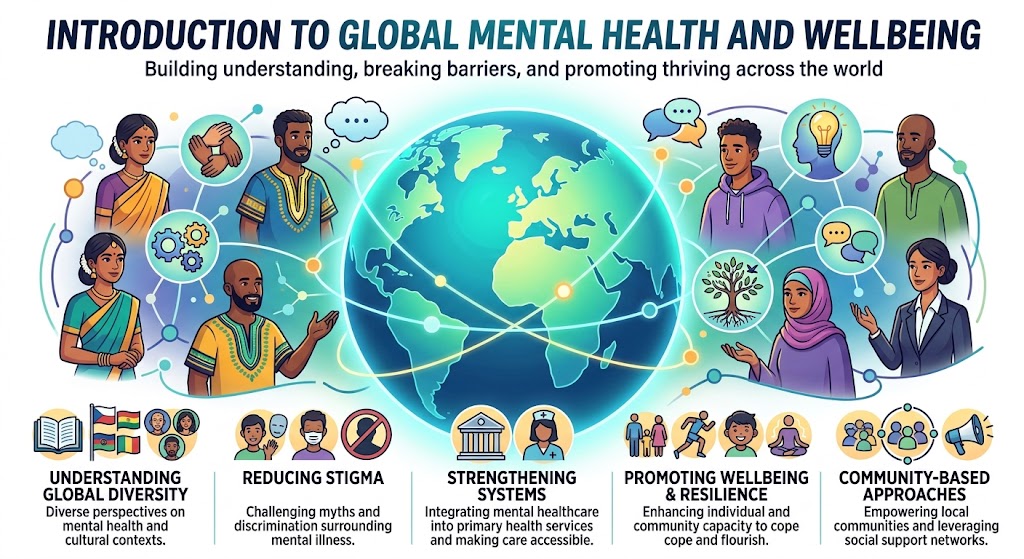
Introduction to Global Mental Health and Wellbeing (Short Course)
Validated by University of Essex Online
Duration
13 weeksStudy Mode
OnlineTotal Tuition
£1,543Monthly Payment
One-time paymentQualification
Micro-Credentials / Short CoursesStart Date
January April July SeptemberProgramme Overview
University of Essex Online | 20 Postgraduate Credits | 13 Weeks | 100% Online | CPD Certified
Programme Overview
The Introduction to Global Mental Health and Wellbeing is a 13-week, part-time online professional course from the University of Essex Online, designed to develop a strong understanding of mental health challenges from a global perspective. The course examines how mental health and wellbeing are shaped by social, cultural and economic factors across different countries and populations. Students explore global mental health priorities, the treatment gap, access to effective mental health services, stigma and discrimination, and strategies for preventing mental ill-health and promoting wellbeing. The course is delivered entirely online and includes one week of induction.
This is a 20-credit postgraduate-level University of Essex course, awarded by the University of Essex. It is also accredited by The CPD Certification Service, allowing successful students to formally record the learning as part of their continuing professional development. The CPD accreditation is recognised in more than 100 countries. Successful completion provides 20 academic credits at postgraduate level, together with a digital certificate showing the course studied, credits awarded and transcript. Students may subsequently use the course as a pathway toward further study, including relevant PG Cert, PG Dip or MSc programmes, subject to meeting the entry requirements of the chosen qualification.
The course is particularly suitable for healthcare professionals, public health practitioners, social care professionals, educators, HR professionals, community-development practitioners, NGO and humanitarian workers, managers, policymakers and other professionals who want to strengthen their understanding of mental health in international and multicultural environments. No formal qualifications or previous professional experience are required, making this an accessible option for professionals seeking postgraduate-level learning without committing to a full master's degree. For applicants whose first language is not English, the University normally expects English proficiency equivalent to IELTS Academic 6.5, although applicants without IELTS can take the University's free online English test; nationals of, or applicants with a UK-degree-equivalent qualification from, specified countries are exempt from providing English evidence.
Entry Requirements
Academic entry requirement:
No formal academic qualification or previous professional experience is required.
English requirement:
Applicants whose first language is not English normally require English proficiency equivalent to IELTS Academic 6.5. The University also provides a free online English assessment for applicants who do not have IELTS or an equivalent qualification. Certain nationals and applicants holding a UK-degree-equivalent qualification from specified countries are exempt from providing English-language evidence.
Application/supporting documentation:
The University requires an application form and supporting documents as part of its admissions process. Because no formal qualification is required for entry, applicants should not be positioned as needing a bachelor's degree or professional qualification. The specific supporting documents required should be confirmed during the individual admissions process.
Who is this course for?
This course is particularly relevant to:
Healthcare professionals and healthcare managers
Nurses and allied health professionals
Public health professionals
Mental health and social care workers
Community-development professionals
NGO and humanitarian-sector professionals
HR and employee-wellbeing professionals
Educators and student-support professionals
Government and public-sector professionals
Professionals seeking postgraduate-level mental health knowledge or a pathway into further study
Career Opportunities
Mental Health Programme Coordinator
Public Health Programme Officer
Community Mental Health Programme Officer
Health and Wellbeing Coordinator
Employee Wellbeing / Workplace Wellbeing Officer
Healthcare or Social Care Manager
NGO Mental Health Programme Officer
Health Promotion Officer
Community Development Officer
Mental Health Policy or Programme Support Officer
Programme Highlights
Students examine the major mental health priorities facing populations around the world and develop an understanding of why mental health has become an increasingly important global health and development issue. The topic provides a foundation for considering how countries and organisations can respond to mental health challenges at population level.
This topic explores different definitions, approaches and priorities surrounding mental health and mental illness across countries and cultures. Students consider why approaches may differ between societies and why culturally appropriate perspectives are important when developing mental health policies and services.
Students investigate policies and initiatives designed to reduce the worldwide burden of mental ill-health. The focus encourages students to consider prevention, intervention and population-level strategies that can improve mental health outcomes.
This area examines the social and cultural factors that influence mental health and wellbeing. Students consider how circumstances such as culture, socioeconomic conditions and social environments can shape mental health experiences and influence the development of appropriate services.
Students explore the challenges involved in providing effective mental health services and evidence-based treatments. Particular attention is given to barriers to care and the difficulties faced in settings where mental health services and resources are less developed.
This topic considers how social and cultural environments influence the development and delivery of mental health services. Students gain insight into why approaches that work in one population or country may need to be adapted for another.
Students examine the impact of stigma and discrimination on people experiencing mental health challenges and consider how these issues can affect access to support and treatment. The topic is particularly relevant to professionals working with diverse communities.
The course considers patterns and challenges associated with race in mental health. Students develop greater awareness of how social and demographic factors can influence mental health experiences, service access and outcomes.
Students explore strategies for preventing mental ill-health and promoting positive mental wellbeing around the world. This provides a practical foundation for professionals interested in health promotion, workplace wellbeing, community programmes and population-health initiatives.
The course considers the wider social and economic consequences of mental health challenges. Students develop an understanding of why mental health is not only a clinical concern but also an issue affecting families, communities, workplaces, economies and wider society.
Related Courses
Mental Health over the Life Course (Short Course)
Qualification: Micro-Credentials / Short Courses
Duration: 13 weeks
Tuition: £1,543
View ProgrammeHealthcare Management: Principles and Practices (Short Course)
Qualification: Micro-Credentials / Short Courses
Duration: 13 weeks
Tuition: £1,543
View ProgrammeHealth Promotion (Short Course)
Qualification: Micro-Credentials / Short Courses
Duration: 13 weeks
Tuition: £1,543
View ProgrammeApply for This Programme
You need an UpCaria account before starting your application. Log in to your existing account or create a new one.
🎓 Scholarship Eligibility Checker
Select your country to check whether you may qualify for a scholarship for this programme.

