

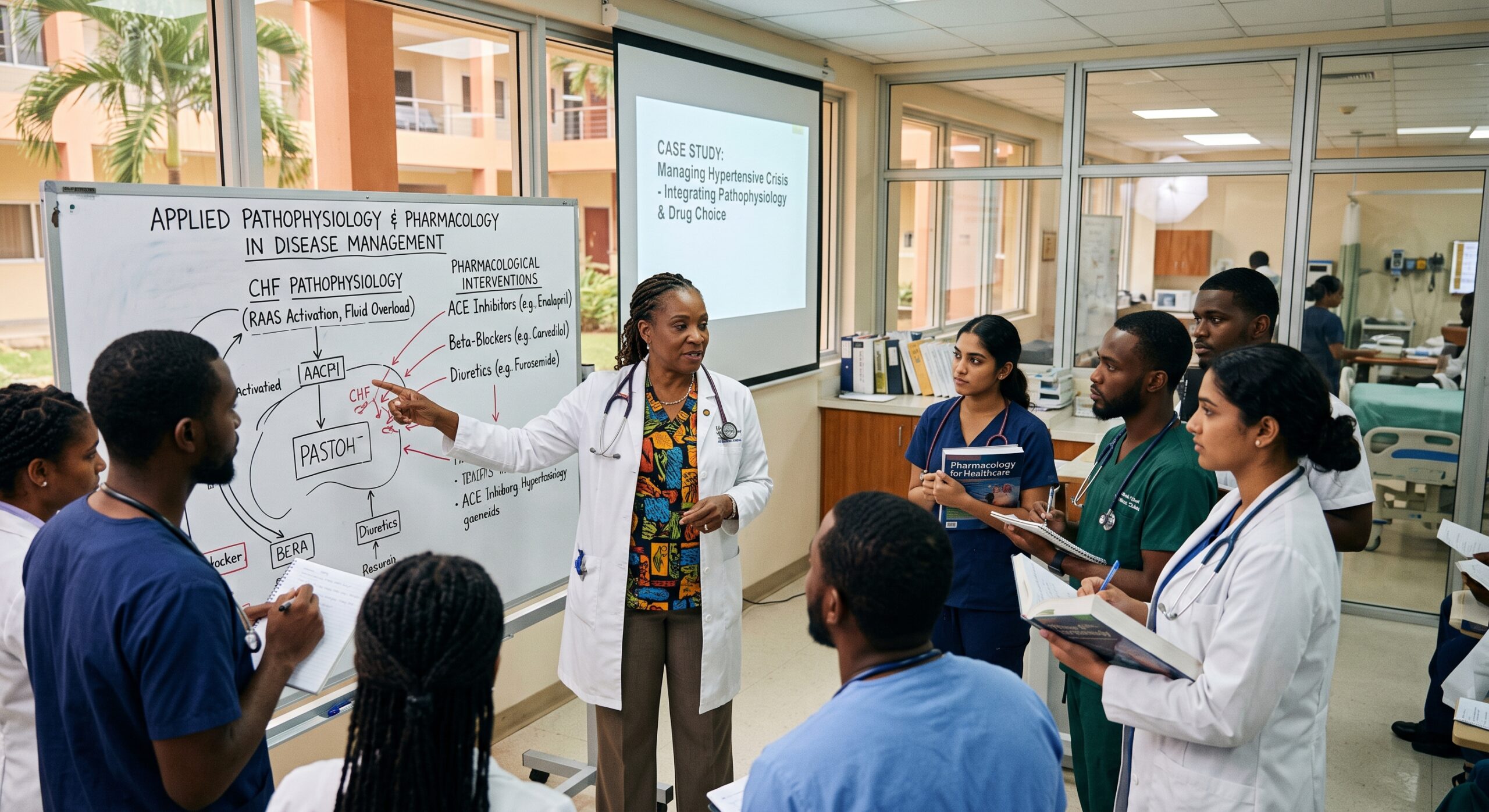
Applied Pathophysiology and Pharmacology in the Management of Disease
Validated by University of Essex Online
Duration
13 weeksStudy Mode
OnlineTotal Tuition
£1,543Monthly Payment
£515Qualification
Micro-Credentials / Short CoursesStart Date
January March May July OctoberProgramme Overview
The University of Essex, a UK university established under Royal Charter in 1965, offers the Applied Pathophysiology and Pharmacology in the Management of Disease course through University of Essex Online. The course is a 20-credit, part-time online professional course designed to develop an applied understanding of physiology, pathology and pharmacology and how these disciplines inform the causes, manifestations, prevention and management of disease. Students examine disease processes, clinical manifestations, the immune system, pharmacodynamics and pharmacokinetics, drug administration, therapeutic agents and medication-related cautions and interactions. The course is awarded by the University of Essex, which is a UK government-recognised university with degree-awarding powers and is registered with the Office for Students (OfS). University of Essex Online is also a recognised member of the Quality Assurance Agency for Higher Education (QAA). Importantly, this particular offering is a professional course rather than a degree or professionally accredited clinical qualification, so students should verify recognition requirements with the relevant Caribbean professional regulator before using it toward licensure or specialist practice.
For Caribbean healthcare professionals, the course offers a practical way to strengthen knowledge of disease mechanisms and medicines without leaving employment or relocating overseas. Its 100% online, part-time format is particularly suitable for nurses, allied health professionals, healthcare workers and others who need to balance professional responsibilities with continuing education. The curriculum has strong relevance to Caribbean healthcare environments where the effective management of chronic and communicable diseases, including hypertension, diabetes, infections and inflammatory conditions, remains important. Students can apply the scientific principles covered in the course to their existing clinical or healthcare-support roles while developing a stronger foundation for further postgraduate study. The course can also serve as a stepping stone toward selected University of Essex Online postgraduate health programmes, including areas such as nursing, infection control and public health, subject to the entry requirements of the subsequent programme.
Entry Requirements
Open enrollment
Applicants must demonstrate a high level of English proficiency.
Where English is not the applicant's first language, the expected standard is equivalent to IELTS Academic 6.5.
Applicants who do not have IELTS or an equivalent qualification can use the University's free online English test to demonstrate their proficiency.
Certain nationals, or applicants who have completed a qualification equivalent to a UK degree in specified countries, may not need to provide separate evidence of English proficiency.
Places are limited, so applicants are encouraged to apply early for their preferred intake.
Who is this course for?
This course is particularly appropriate for:
Registered nurses and nursing professionals.
Allied health professionals.
Healthcare assistants and experienced healthcare workers seeking academic development.
Public health and community health professionals.
Healthcare professionals involved in chronic disease management.
Professionals working with medication administration or therapeutic interventions.
Healthcare managers who want stronger clinical-science knowledge.
Professionals seeking continuing professional development (CPD).
Caribbean healthcare workers preparing for postgraduate study.
Individuals interested in developing foundational knowledge in disease mechanisms and pharmacology.
Career Opportunities
Registered Nurse / Senior Nurse – Strengthens understanding of disease mechanisms and pharmacological interventions relevant to patient care.
Clinical Nurse Specialist – Supports more informed interpretation of disease processes and therapeutic approaches.
Community Health Professional – Useful for understanding disease prevention, chronic disease and medication-related issues in community settings.
Public Health Practitioner – Provides foundational knowledge applicable to disease prevention and population health initiatives.
Healthcare Educator – Strengthens the scientific foundation needed to educate patients, healthcare workers and communities.
Clinical Support Professional – Enhances understanding of clinical manifestations and therapeutic agents.
Chronic Disease Management Professional – Particularly relevant to professionals working with conditions such as hypertension and diabetes.
Healthcare Manager – Adds clinical-science knowledge that can complement existing healthcare management responsibilities.
Clinical Research Support Professional – Provides foundational knowledge of disease processes and therapeutic interventions relevant to healthcare research environments.
Postgraduate Health Student Pathway – Can provide useful academic preparation for eligible students progressing into postgraduate health programmes, subject to the subsequent programme's admissions requirements.
Programme Highlights
This area establishes the scientific foundation for understanding how disease develops and affects the human body. Students examine the definitions and principles associated with physiology, pathology and pathophysiology, including how normal biological processes become altered through disease. For Caribbean healthcare professionals, this foundation can improve the ability to connect a patient's symptoms and clinical presentation with the underlying disease process
Students explore the signs and symptoms associated with disease, developing a stronger understanding of clinical manifestations. This is important because healthcare professionals must be able to recognise changes in patient condition and understand how those changes relate to underlying pathology. The knowledge can be particularly valuable in Caribbean healthcare settings where professionals manage patients across primary care, community health, hospitals and long-term care environments.
The course examines different stages and patterns of disease, including acute, chronic and acute-on-chronic conditions. This provides students with a framework for understanding how diseases develop and change over time. The subject is especially relevant to Caribbean healthcare because many professionals work with patients requiring long-term management of chronic conditions while also responding to acute episodes.
Students receive a basic overview of the immune system, including innate and specific immunity. Understanding immune responses is fundamental to appreciating how the body responds to infection, inflammation and other disease processes. This knowledge can support healthcare professionals working in infection control, community health, chronic disease management and patient education.
The course examines primary, secondary and tertiary prevention, giving students a structured understanding of how disease can be prevented, detected early and managed to reduce complications. This is particularly valuable for Caribbean healthcare systems, where prevention and early intervention can help reduce the burden associated with chronic diseases and communicable illnesses.
This is one of the most important pharmacology components of the course. Pharmacodynamics considers what a drug does to the body, while pharmacokinetics considers what the body does to a drug, including processes such as absorption, distribution, metabolism and elimination. Developing an understanding of these concepts can help healthcare professionals better appreciate why medicines produce particular effects and why dosage, timing and patient characteristics can influence therapeutic outcomes.
Students examine different routes of drug administration, including oral and parenteral administration, alongside examples of commonly used therapeutic agents. The course specifically identifies areas such as anti-inflammatory agents, antibiotics and antihypertensives. This has direct relevance to Caribbean healthcare professionals who encounter medication management across hospitals, clinics, community health and chronic disease programmes.
The course addresses regulatory principles associated with the dispensing of therapeutic agents, as well as the importance of recording and communicating medication use. This component reinforces the importance of appropriate medication practices, documentation and communication among healthcare professionals—areas that are critical to patient safety.
Students examine important medication warning signs, including cautions, contraindications, drug interactions and idiosyncratic reactions. This knowledge can help healthcare professionals identify situations in which a therapeutic agent may be inappropriate or potentially harmful and strengthens the clinical reasoning needed to support safer medication-related decision-making.
The overarching value of the course is its integration of physiology, pathology and pharmacology into the management of disease. Rather than treating these areas as isolated subjects, students develop an understanding of how disease mechanisms, clinical manifestations, prevention and therapeutic interventions relate to one another. For Caribbean healthcare professionals, this integrated perspective can strengthen clinical knowledge while providing a useful foundation for continuing professional development and further postgraduate healthcare education.
Related Courses
Introduction to Global Mental Health and Wellbeing (Short Course)
Qualification: Micro-Credentials / Short Courses
Duration: 13 weeks
Tuition: £1,543
View ProgrammeMental Health over the Life Course (Short Course)
Qualification: Micro-Credentials / Short Courses
Duration: 13 weeks
Tuition: £1,543
View ProgrammeHealthcare Management: Principles and Practices (Short Course)
Qualification: Micro-Credentials / Short Courses
Duration: 13 weeks
Tuition: £1,543
View ProgrammeApply for This Programme
You need an UpCaria account before starting your application. Log in to your existing account or create a new one.
🎓 Scholarship Eligibility Checker
Select your country to check whether you may qualify for a scholarship for this programme.