

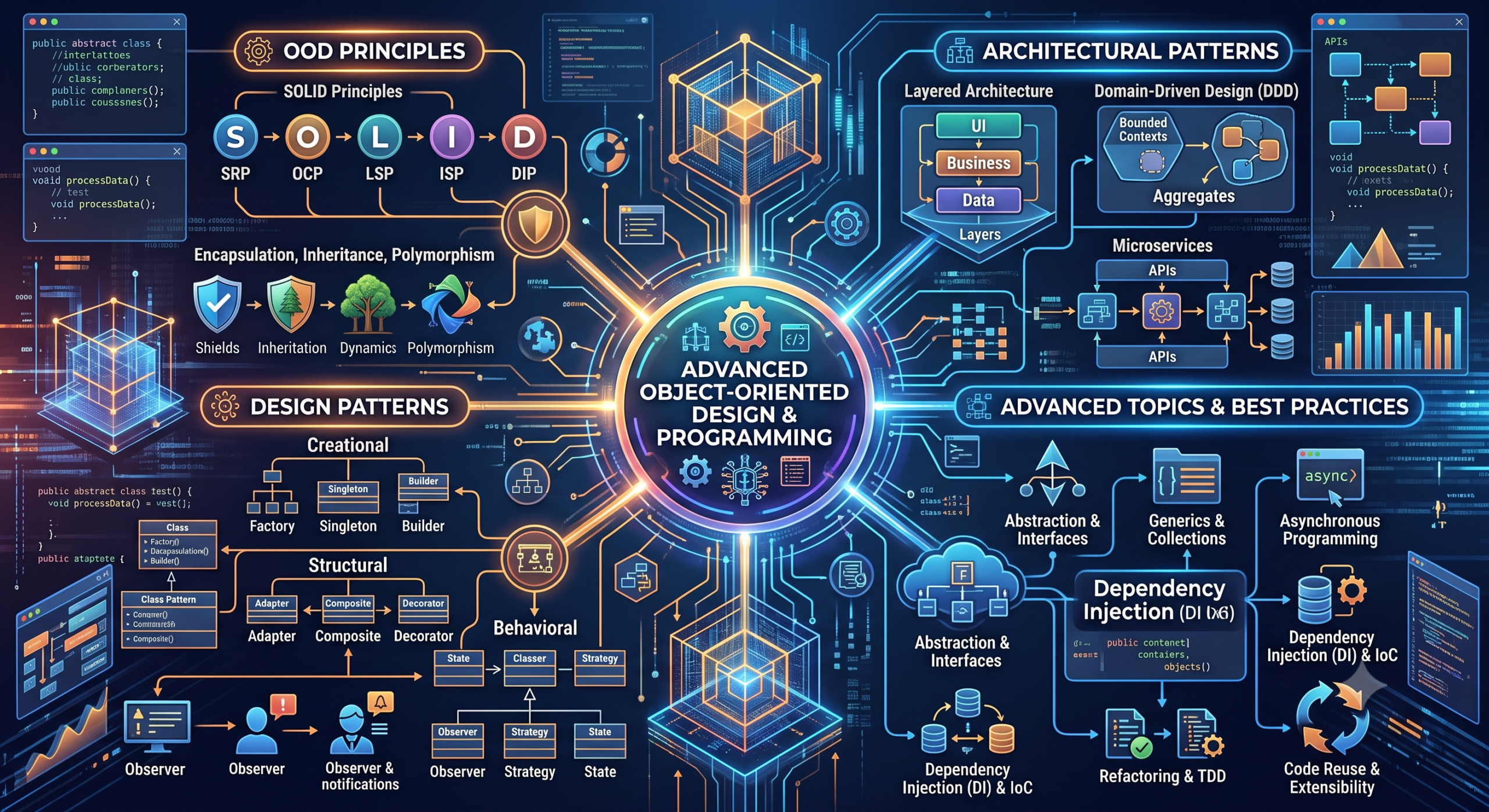
Advanced Object-Oriented Design and Programming
Validated by University of Essex Online
Duration
13 vweeksStudy Mode
OnlineTotal Tuition
£1,543Monthly Payment
£515Qualification
Micro-Credentials / Short CoursesStart Date
July, OctoberProgramme Overview
The Advanced Object-Oriented Design and Programming online professional course from the University of Essex Online is designed for learners who want to build advanced software engineering skills that are highly valued in today's digital economy. Delivered over 13 weeks on a flexible, part-time basis, the course explores modern object-oriented programming (OOP), software architecture, secure coding, design patterns, concurrency, and test-driven development. Students develop the ability to write efficient, maintainable, scalable, and secure software solutions that can be applied across industries such as artificial intelligence, cybersecurity, cloud computing, financial technology, healthcare, telecommunications, and government. For Caribbean professionals seeking to advance their programming expertise while maintaining full-time employment, this course provides practical, industry-focused knowledge that can immediately be applied within regional and international technology environments.
Entry Requirements
Applicants must meet the following requirements:
No formal academic qualifications or previous programming experience are required.
A high level of English proficiency is expected.
If English is not your first language, proficiency should be equivalent to IELTS Academic 6.5.
Applicants without IELTS may complete the University's free online English assessment.
The programme is therefore accessible to both recent graduates and experienced professionals wishing to upskill or transition into software development.
Who is this course for?
This programme is ideal for:
Software Developers seeking advanced programming techniques
Computer Science graduates
IT Professionals looking to strengthen software engineering skills
AI and Machine Learning practitioners
Cybersecurity professionals
Cloud Computing specialists
Data Scientists
Systems Analysts
DevOps Engineers
Caribbean professionals preparing for international technology careers
Individuals planning to progress to a Master's degree in Computing
Career Opportunities
Senior Software Developer
Software Engineer
Backend Developer
Full-Stack Developer
Solutions Architect
Systems Analyst
Cloud Software Engineer
DevOps Engineer
Application Security Developer
Technical Lead / Software Development Team Leader
Programme Highlights
This module introduces the five SOLID principles that underpin modern software engineering. Students learn how to design applications that are scalable, maintainable, and easy to modify as business requirements evolve. Mastering these principles enables developers to produce high-quality code that reduces technical debt and supports long-term software development. These skills are essential for building enterprise applications across industries such as banking, telecommunications, healthcare, and government throughout the Caribbean.
Design patterns are proven solutions to common software design challenges. This module teaches students how to apply industry-standard patterns to create flexible, reusable, and efficient software systems. Learners gain practical experience in selecting the right pattern for different programming scenarios, improving code quality while reducing development time. Knowledge of design patterns is highly valued by employers because it demonstrates an advanced understanding of software architecture and object-oriented design.
This module focuses on designing robust software systems that can scale to support thousands or even millions of users. Students explore architectural principles that promote modularity, maintainability, and performance while aligning technical solutions with organisational goals. By understanding software architecture, learners are better prepared to contribute to large-scale enterprise systems, cloud applications, and digital transformation projects across the Caribbean and internationally.
Security is an essential aspect of modern software development. In this module, students learn how to identify common programming vulnerabilities and implement secure coding techniques that protect applications from cyber threats. Topics include input validation, authentication, secure data handling, and defensive programming. These skills are particularly valuable for professionals working in financial services, healthcare, government, and any organisation that manages sensitive information.
This module introduces modern software testing methodologies that improve code quality and reduce defects throughout the development lifecycle. Students learn how to write automated tests before developing application features, ensuring software is reliable, maintainable, and easier to update. By incorporating TDD and BDD into agile development practices, learners develop the ability to deliver robust software more efficiently—an increasingly important capability for software engineering teams worldwide.
Related Courses
Advanced Diploma in Information Technology
Qualification: Professional Diploma
Duration: 12 months
Tuition: €4,000
View ProgrammeBachelor of Science in Business Information Technology (IT)
Qualification: Bachelor’s Degree
Duration: 3 Years
Tuition: €12,000
View ProgrammeBachelor of Science (BSc) in Artificial Intelligence
Qualification: Bachelor’s Degree
Duration: 3 years
Tuition: €10,500
View ProgrammeApply for This Programme
You need an UpCaria account before starting your application. Log in to your existing account or create a new one.
🎓 Scholarship Eligibility Checker
Select your country to check whether you may qualify for a scholarship for this programme.