

Medical Education MSc
Validated by University of South Wales
Duration
24 MonthsStudy Mode
OnlineTotal Tuition
£9,440Monthly Payment
—Qualification
Master’s Degree (MSc / MA / MPH)Start Date
Jan, Mar, May, Jul, Sep, NovProgramme Overview
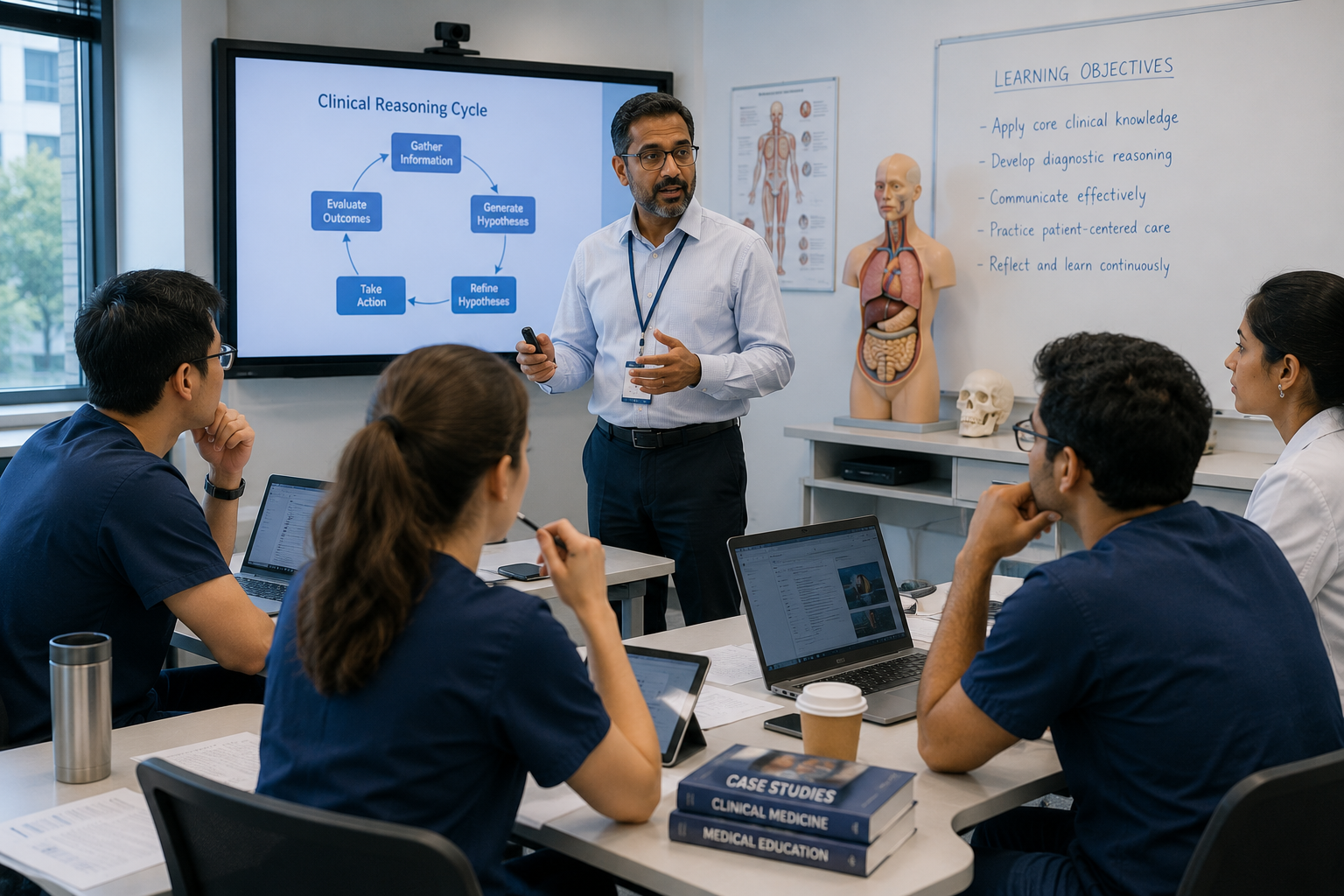
The MSc Medical Education is a Level 7 postgraduate degree delivered by Diploma MSc and validated by the University of South Wales (USW). The programme is designed for healthcare professionals who want to develop advanced expertise in teaching, assessment, curriculum development, educational leadership and research while continuing to work. It is a 24-month, 100% online, part-time MSc comprising eight modules and 180 credits, making it particularly attractive to professionals who cannot leave their clinical or healthcare responsibilities to study full-time. The programme also has strong professional recognition: it carries triple-accreditation status, including AccreditationPlus from the Academy of Medical Educators (AoME)—its highest accreditation level—and is accredited for CPD by the Federation of the Royal Colleges of Physicians of the UK. For Caribbean healthcare professionals, this combination of a UK university-validated master's degree, professional recognition, online delivery and an evidence-based curriculum provides an opportunity to strengthen healthcare education capabilities without relocating from the Caribbean.
For Caribbean doctors, nurses and other healthcare professionals, the MSc Medical Education offers a practical pathway to move beyond clinical practice into teaching, mentoring, assessment, curriculum development and healthcare education leadership. Its online structure allows professionals across Jamaica, Trinidad & Tobago, Barbados, Guyana, St. Lucia and other Caribbean markets to study while remaining in their home country and continuing their professional responsibilities. The programme's emphasis on educational quality, digital learning, leadership, research and patient-care outcomes is especially relevant to Caribbean health systems seeking to strengthen the preparation and continuous professional development of healthcare workers. Students also complete an independent professional research project connected to their own practice, allowing them to investigate a real medical-education challenge and potentially contribute evidence-based improvements to their institution or healthcare system
Entry Requirements
Since our courses are conducted entirely online, they are accessible to both UK and international registered healthcare professionals.
Applicants will typically hold a first degree or equivalent (including international qualifications) in a relevant professional healthcare field, such as a medical or nursing degree.
Registered healthcare professionals without these recognised qualifications will be considered on an individual basis and a wide range of prior experience may be taken into account. In some cases, applicants may be asked to submit a piece of work for assessment in order to confirm that they are able to work comfortably at postgraduate level, and demonstrate the requisite clinical and professional knowledge.
Documents Required
A copy of your updated CV including your address and date of birth.
A copy of your undergraduate degree certificate.
The name and email address of someone who is able to provide a reference, this can be a work colleague, employer or former tutor.
A detailed personal statement explaining why you would like to undertake the course.
A copy of your proof of English competency (see below).
English Language Requirements Proficiency in the English language is also essential to completing our courses. If English is NOT your first language, we ask for proof of competency during the application process. We are able to accept an IELTS overall score of 6.0 (with a minimum of 5.5 for each band) or an equivalent qualification.
If you do not meet these requirements, please don’t worry. The University of South Wales run a number of English Language Programmes at the Centre for International English to prepare you for your academic studies. You can also contact our admissions team on admissions@diploma-msc.com for more information on the qualifications we accept.
Should you have already successfully completed the 1 year Postgraduate Diploma and wish to convert to the MSc and complete only the second year of the programme this is possible. Please contact our admissions department admissions@diploma-msc.com to find out more.
Who is this course for?
This MSc is particularly suited to:
Doctors and physicians.
General practitioners.
Nurses and nurse educators.
Healthcare professionals involved in teaching or mentoring.
Clinical educators and trainers.
Healthcare professionals involved in assessment or supervision.
Academic healthcare professionals.
Healthcare managers involved in professional development.
Professionals responsible for curriculum or programme development.
Healthcare professionals seeking educational leadership or academic career advancement.
The university specifically identifies doctors, GPs and healthcare professionals as suitable candidates, while professionals with related undergraduate degrees or equivalent professional qualifications and experience may also be considered
Career Opportunities
Medical Education Specialist
Clinical Educator
Medical School Lecturer
Healthcare Education Manager
Clinical Training Manager
Nurse Educator / Nurse Academic
Curriculum Development Specialist
Assessment and Examination Specialist
Healthcare Education Programme Director
Medical Education Researcher
Programme Highlights
This foundational module develops the student's understanding of how healthcare professionals learn and how effective medical education can be delivered. Students explore learning and teaching theories, teaching methods, lesson planning, individual and group teaching, practical teaching skills and online learning. For Caribbean healthcare professionals who already teach students, junior doctors, nurses or colleagues, this module provides a stronger theoretical and practical foundation for becoming a more effective educator.
Students learn how to evaluate medical-education programmes and determine whether educational interventions are actually producing meaningful results. Topics include the regulatory context of medical education, Moore's levels, programme evaluation and case studies. This is particularly valuable for professionals who may become responsible for measuring the effectiveness of training programmes, improving educational quality and demonstrating the impact of healthcare education on patient care.
This module focuses on one of the most important responsibilities of a healthcare educator: determining whether learners have achieved the required competencies. Students examine performance testing, formative and summative assessment, assessment construction, supervision, feedback and appraisal. The knowledge gained can be applied to clinical training, professional examinations, workplace assessment and continuing professional development programmes throughout Caribbean healthcare institutions.
The Media module addresses the growing importance of technology in healthcare education. Students examine educational technology, presentation skills, simulation, augmented and virtual reality, big clinical data, emerging technologies, mobile learning, social media and digital learning environments. For Caribbean institutions increasingly using online education, simulation and digital professional development, this module can help educators design more engaging and technology-enabled learning experiences.
This module develops the leadership capabilities needed to influence medical education and ultimately contribute to improved patient care. Students examine educational leadership, monitoring healthcare professionals, AoME professional domains, policy and strategy, ethics and scholarship. It is particularly relevant for Caribbean healthcare professionals seeking positions such as programme leaders, clinical education managers, department heads or senior academic and professional-development roles.
The Curriculum module teaches students how to design, develop, implement and critically evaluate healthcare education programmes. Topics include curriculum planning, programme design, quality assurance, assessment, evaluation, service-user involvement and Biggs' Constructive Alignment. This knowledge can be directly relevant to Caribbean universities, hospitals, nursing schools and healthcare organisations seeking to strengthen or modernise professional education programmes.
In Year 2, students develop the research skills required to investigate important questions in medical education. The module covers quantitative and qualitative research, statistical interpretation, systematic reviews, meta-analysis, evidence appraisal, audit, governance, quality improvement, health economics, research proposals and research ethics. This equips Caribbean healthcare professionals to critically assess evidence and undertake research that can inform improvements in healthcare education and service delivery.
The Professional Project provides the opportunity to apply the knowledge developed throughout the MSc to an original medical-education investigation relevant to the student's professional practice. Depending on the student's interests, the project may involve a systematic review, organisational audit, evidence-based practice project, research proposal, quality review, case-based investigation or secondary-data analysis. For Caribbean students, this creates an excellent opportunity to investigate a genuine education or workforce-development issue within their own hospital, university, nursing programme or healthcare organisation.
Related Courses
Introduction to Global Mental Health and Wellbeing (Short Course)
Qualification: Micro-Credentials / Short Courses
Duration: 13 weeks
Tuition: £1,543
View ProgrammeMental Health over the Life Course (Short Course)
Qualification: Micro-Credentials / Short Courses
Duration: 13 weeks
Tuition: £1,543
View ProgrammeHealthcare Management: Principles and Practices (Short Course)
Qualification: Micro-Credentials / Short Courses
Duration: 13 weeks
Tuition: £1,543
View ProgrammeMedical Education PGCert
Validated by University of South Wales
Duration
6 MonthsStudy Mode
OnlineTotal Tuition
£2,900Monthly Payment
—Qualification
Postgraduate CertificateStart Date
Jan, Mar, May, Jul, Sep, NovProgramme Overview
In today’s healthcare landscape, formal teaching qualifications are becoming essential. Our Postgraduate Certificate in Medical Education is your fast-track route to becoming a recognised medical educator—100% online, highly flexible, and designed for busy professionals like you. In just six months, you’ll gain the expertise to deliver high-quality teaching, strengthen your leadership skills, and advance your career in medical education.
What sets our PG certificate in medical education apart is our accreditation status from the Academy of Medical Educators (AoME) ensures your qualification is widely recognised. You’ll benefit from a dynamic, interactive learning experience, with scenario-based discussions that sharpen your analytical skills—making you more marketable to employers. Unlike many institutions, our certificate course in medical education is built around truly flexible, self-paced learning, without the constraints of scheduled online sessions that disrupt your clinical responsibilities and personal life.
On top of this, we offer one of the most affordable routes to qualification among comparable offerings. Our certificate in medical education online provides exceptional value, combined with quality education that aligns with your professional goals enhancing its accessibility and appeal. Whether you’re looking to enhance your teaching credentials or open doors to further career progression, this postgraduate certificate in medical education online is your stepping stone to a stronger professional profile and greater career opportunities.
Entry Requirements
Since our courses are conducted entirely online, they are accessible to both UK and international registered healthcare professionals.
Applicants will typically hold a first degree or equivalent (including international qualifications) in a relevant professional healthcare field, such as a medical or nursing degree.
Registered healthcare professionals without these recognised qualifications will be considered on an individual basis and a wide range of prior experience may be taken into account. In some cases, applicants may be asked to submit a piece of work for assessment in order to confirm that they are able to work comfortably at postgraduate level, and demonstrate the requisite clinical and professional knowledge.
Documents Required
A copy of your updated CV including your address and date of birth.
A copy of your undergraduate degree certificate.
The name and email address of someone who is able to provide a reference, this can be a work colleague, employer or former tutor.
A detailed personal statement explaining why you would like to undertake the course.
A copy of your proof of English competency (see below).
English Language Requirements Proficiency in the English language is also essential to completing our courses. If English is NOT your first language, we ask for proof of competency during the application process. We are able to accept an IELTS overall score of 6.0 (with a minimum of 5.5 for each band) or an equivalent qualification.
If you do not meet these requirements, please don’t worry. The University of South Wales run a number of English Language Programmes at the Centre for International English to prepare you for your academic studies. You can also contact our admissions team on admissions@diploma-msc.com for more information on the qualifications we accept.
Who is this course for?
This postgraduate diploma in medical education is specifically designed for healthcare professionals seeking to advance their expertise in medical education. It caters to a diverse range of roles, including:
GPs (General Practitioners)
This programme provides GPs with advanced teaching methodologies and leadership skills, enabling GPs to enhance their role in medical education, improve learner assessments, and optimise educational outcomes in primary care settings.
Nurses
This diploma equips nurses with a deeper understanding of curriculum development, educational theory, and assessment techniques, enabling nurses to create more structured and effective training programmes for both peers and patients.
Clinical Educators and Trainers
This programme provides clinical educators with the latest tools and techniques in education, including the use of educational technology, allowing them to design impactful, engaging learning experiences for healthcare professionals.
Physician Associates (PAs)
As PAs become increasingly integral to healthcare teams, their involvement in training the next generation of PAs and other healthcare professionals grows. This diploma helps PAs enhance their teaching and assessment skills, allowing them to contribute effectively to the education of new clinicians and support staff.
Pharmacists
This programme provides pharmacists with enhanced skills in educational theory and practice, enabling them to design, deliver, and assess more effective educational interventions for both healthcare professionals and patients.
Physiotherapists
Physiotherapists often take on teaching responsibilities, whether training junior staff or educating patients about rehabilitation practices. This diploma gives them the ability to structure and deliver educational content more effectively, ensuring that training and patient education efforts are evidence-based and impactful.
Dietitians
Through this programme, dietitians gain advanced skills in creating educational materials and programmes, enhancing their ability to deliver effective, structured training sessions that improve healthcare delivery and patient outcomes.
Programme Highlights
Programme highlights coming soon.
Related Courses
Introduction to Global Mental Health and Wellbeing (Short Course)
Qualification: Micro-Credentials / Short Courses
Duration: 13 weeks
Tuition: £1,543
View ProgrammeMental Health over the Life Course (Short Course)
Qualification: Micro-Credentials / Short Courses
Duration: 13 weeks
Tuition: £1,543
View ProgrammeHealthcare Management: Principles and Practices (Short Course)
Qualification: Micro-Credentials / Short Courses
Duration: 13 weeks
Tuition: £1,543
View ProgrammeMedical Education PGDip
Validated by University of South Wales
Duration
12 monthsStudy Mode
OnlineTotal Tuition
£5,040Monthly Payment
£420Qualification
Postgraduate DiplomaStart Date
Jan, Mar, May, Jul, Sep, NovProgramme Overview
The Postgraduate Diploma in Medical Education (PGDip) is a Level 7, 120-credit postgraduate qualification validated by the University of South Wales (USW) and delivered by Learna | Diploma MSc. The programme is designed specifically for healthcare professionals who want to develop stronger expertise in teaching, assessment, curriculum development, educational leadership and the use of technology in healthcare education. It is delivered 100% online, part-time over 12 months, making it particularly suitable for Caribbean healthcare professionals who need to continue working while pursuing an internationally recognised UK postgraduate qualification. The programme is also recognised through AoME AccreditationPlus (Academy of Medical Educators) and is accredited for CPD by the Federation of the Royal Colleges of Physicians of the UK.
For healthcare professionals across Jamaica, Barbados, Trinidad & Tobago, Guyana, The Bahamas, St Lucia, St Vincent and the Grenadines, Grenada, Antigua & Barbuda, St Kitts & Nevis, Dominica and other English-speaking Caribbean territories, the programme offers a practical way to build specialist capacity without leaving the region. Its online format eliminates the need to relocate or take extended time away from clinical employment, while much of the learning is designed around applying educational theory to professional practice. This is particularly relevant for doctors, nurses, allied health professionals, clinical tutors, supervisors and healthcare managers who are increasingly involved in staff training, student supervision, competency assessment and continuing professional development.
The programme is also relevant to the Caribbean's continuing need to strengthen the quality and consistency of healthcare education and clinical training. Students work with clinical cases, peer discussions, reflective learning and assignments rather than relying solely on traditional lectures. The six modules cover the complete educational process—from how healthcare professionals teach and assess learners to how curricula are designed, programmes are evaluated, technology is incorporated and educational teams are led. Graduates can therefore apply the knowledge within hospitals, universities, nursing schools, medical schools, public-health organisations, professional training departments and other healthcare education environments.
Entry Requirements
Since our courses are conducted entirely online, they are accessible to both UK and international registered healthcare professionals.
Applicants will typically hold a first degree or equivalent (including international qualifications) in a relevant professional healthcare field, such as a medical or nursing degree.
Registered healthcare professionals without these recognised qualifications will be considered on an individual basis and a wide range of prior experience may be taken into account. In some cases, applicants may be asked to submit a piece of work for assessment in order to confirm that they are able to work comfortably at postgraduate level, and demonstrate the requisite clinical and professional knowledge.
Documents Required
A copy of your updated CV including your address and date of birth.
A copy of your undergraduate degree certificate.
The name and email address of someone who is able to provide a reference, this can be a work colleague, employer or former tutor.
A detailed personal statement explaining why you would like to undertake the course.
A copy of your proof of English competency (see below).
English Language Requirements Proficiency in the English language is also essential to completing our courses. If English is NOT your first language, we ask for proof of competency during the application process. We are able to accept an IELTS overall score of 6.0 (with a minimum of 5.5 for each band) or an equivalent qualification.
If you do not meet these requirements, please don’t worry. The University of South Wales run a number of English Language Programmes at the Centre for International English to prepare you for your academic studies. You can also contact our admissions team on admissions@diploma-msc.com for more information on the qualifications we accept.
Should you have already successfully completed the 1 year Postgraduate Diploma and wish to convert to the MSc and complete only the second year of the programme this is possible. Please contact our admissions department admissions@diploma-msc.com to find out more.
Who is this course for?
The PGDip is particularly suitable for:
Doctors and physicians involved in teaching or supervision
Resident and foundation-level doctors
Specialist and SAS doctors with educational responsibilities
Nurses and nurse educators
Clinical tutors and educational supervisors
Allied health professionals involved in teaching
Healthcare professionals involved in assessment
Clinical mentors and preceptors
Healthcare professionals involved in curriculum development
Medical and healthcare educators
Programme leads and healthcare training managers
International healthcare professionals seeking a UK university-validated qualification in medical education
Career Opportunities
Medical Educator
Clinical Tutor
Healthcare Education Coordinator
Nurse Educator
Clinical Education Lead
Medical Education Programme Lead
Healthcare Training Manager
Educational Supervisor
Curriculum Development Specialist
Clinical Skills & Simulation Educator
Programme Highlights
This module establishes the foundation for effective healthcare education. Students explore learning and teaching theories, teaching methods, lesson planning, practical teaching skills, individual and group teaching, online learning and contemporary issues in medical education. The emphasis is on applying appropriate teaching approaches while understanding how effective medical education ultimately supports better patient care.
Students develop an advanced understanding of assessment within medical education, including performance testing, formative and summative assessment, assessment design, supervision, appraisal and feedback. The module is particularly relevant to Caribbean healthcare professionals responsible for determining whether students, residents or practicing professionals have achieved required competencies.
This module focuses on evaluating educational programmes and activities. Students examine regulatory considerations, evaluation models such as Moore's framework, programme evaluation and case studies. The knowledge gained can support healthcare institutions in measuring whether training programmes are achieving their intended outcomes and identifying areas for continuous improvement.
Students examine the growing role of digital technology in healthcare education, including educational media, presentation skills, simulation, augmented and virtual reality, big clinical data, emerging technologies, mobile learning, social media and digital learning environments. This is particularly relevant as Caribbean medical and nursing education increasingly incorporates online learning, simulation and digital resources.
This module examines leadership within medical education, including monitoring healthcare professionals' performance, professional standards, policy and strategy, ethics and scholarship. It is valuable for clinicians who have moved into supervisory, academic, departmental or healthcare training leadership roles and need to combine clinical expertise with educational leadership.
Students learn how to design, develop and evaluate healthcare education curricula. Topics include curriculum planning, programme design, quality assurance, assessment, evaluation, service-user involvement and Biggs' Constructive Alignment. The module provides practical knowledge for professionals involved in developing or reviewing medical, nursing, allied-health and continuing-professional-development programmes.
Related Courses
Introduction to Global Mental Health and Wellbeing (Short Course)
Qualification: Micro-Credentials / Short Courses
Duration: 13 weeks
Tuition: £1,543
View ProgrammeMental Health over the Life Course (Short Course)
Qualification: Micro-Credentials / Short Courses
Duration: 13 weeks
Tuition: £1,543
View ProgrammeHealthcare Management: Principles and Practices (Short Course)
Qualification: Micro-Credentials / Short Courses
Duration: 13 weeks
Tuition: £1,543
View ProgrammeApply for This Programme
You need an UpCaria account before starting your application. Log in to your existing account or create a new one.
🎓 Scholarship Eligibility Checker
Select your country to check whether you may qualify for a scholarship for this programme.

