

Critical Care MSc
Validated by University of Buckingham
Duration
24 MonthsStudy Mode
OnlineTotal Tuition
£8,400Monthly Payment
—Qualification
Master’s Degree (MSc / MA / MPH)Start Date
Jan, Mar, May, Jul, Sep, NovProgramme Overview
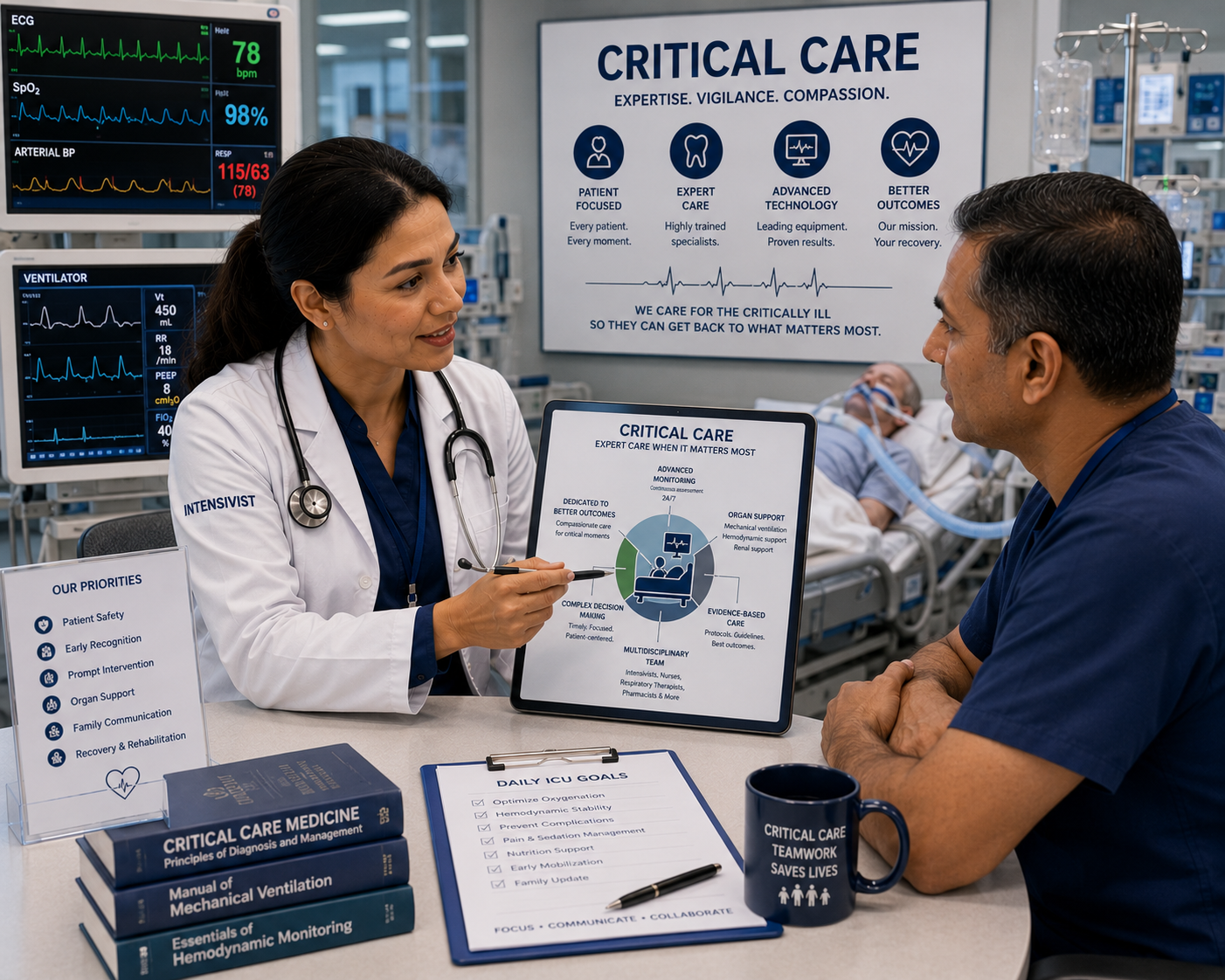
The MSc in Critical Care is a two-year, part-time, 100% online master’s programme designed for healthcare professionals who want to develop advanced knowledge and clinical decision-making skills in the management of critically ill patients. The programme covers major areas of critical care including respiratory failure, mechanical ventilation, sepsis, cardiovascular support, heart failure, postoperative care, traumatic and non-traumatic head injuries, critical-care rehabilitation, ethics and law, and healthcare research. The programme comprises 180 credits across seven modules, with the first 120 credits forming the Postgraduate Diploma and the final year focused on research methodologies, critical appraisal and a professional project.
The degree is validated by the University of Buckingham, with the official qualification awarded by the university. The programme is particularly relevant to Caribbean healthcare systems because it allows doctors, nurses, paramedics, pharmacists and other registered healthcare professionals to gain specialist postgraduate education without leaving the Caribbean or interrupting full-time employment. Its emphasis on evidence-based practice, multidisciplinary teamwork, emergency decision-making and critical-care leadership can be valuable for hospitals and healthcare services across Jamaica, Trinidad & Tobago, Barbados, Guyana, The Bahamas and the wider Caribbean, particularly as regional health systems continue to strengthen emergency, intensive-care and specialist services. However, prospective Caribbean students should confirm recognition or professional-credit requirements with their local medical, nursing or other relevant regulatory council, because the programme provider explicitly notes that recognition of postgraduate medical qualifications is governed by the rules of each country's professional regulator.
Entry Requirements
Since our courses are conducted entirely online, they are accessible to both UK and international registered healthcare professionals.
Applicants will typically hold a first degree or equivalent (including international qualifications) in a relevant professional healthcare field, such as a medical or nursing degree.
Registered healthcare professionals without these recognised qualifications will be considered on an individual basis and a wide range of prior experience may be taken into account. In some cases, applicants may be asked to submit a piece of work for assessment in order to confirm that they are able to work comfortably at postgraduate level, and demonstrate the requisite clinical and professional knowledge.
Documents Required
A copy of your updated CV including your address and date of birth.
A copy of your undergraduate degree certificate.
The name and email address of someone who is able to provide a reference, this can be a work colleague, employer or former tutor.
A detailed personal statement explaining why you would like to undertake the course.
A copy of your proof of English competency (see below).
English Language Requirements Proficiency in the English language is also essential to completing our courses. If English is NOT your first language, we ask for proof of competency during the application process. We are able to accept an IELTS overall score of 6.5 (with a minimum of 6.0 for each band) or an equivalent qualification.
If you do not meet these requirements, please don’t worry. The University of Buckingham run a number of English Language Programmes at the Centre for International English to prepare you for your academic studies. You can also contact our admissions team on admissions@diploma-msc.com for more information on the qualifications we accept.
Should you have already successfully completed the 1 year Postgraduate Diploma and wish to convert to the MSc and complete only the second year of the programme this is possible. Please contact our admissions department admissions@diploma-msc.com to find out more.
Who is this course for?
Doctors and physicians.
Registered nurses.
Emergency-care and ICU nurses.
Paramedics.
General practitioners seeking advanced critical-care knowledge.
Pharmacists working in acute or hospital environments.
Physician associates/assistants.
Healthcare professionals preparing for leadership responsibilities in intensive or emergency-care settings.
Healthcare professionals seeking career advancement or specialization in critical care.
Experienced healthcare practitioners who want to develop research and evidence-based-practice capabilities
Career Opportunities
Critical Care/ICU Nurse
Advanced Critical Care Practitioner
Emergency Care Practitioner
Critical Care Clinical Team Leader
Intensive Care Unit Nurse Educator
Hospital Critical Care Coordinator
Emergency Department Clinical Leader
Critical Care Quality Improvement Specialist
Healthcare Researcher / Clinical Researcher
Critical Care or Acute-Care Management Professional
Programme Highlights
This module develops advanced knowledge of acute respiratory failure and respiratory support, making it particularly relevant to practitioners working with critically ill patients. Students examine mechanical ventilation modes and strategies, ventilator-associated complications, weaning and extubation, non-invasive ventilation and acute exacerbations of chronic respiratory disease. The module also incorporates ethical decision-making and multidisciplinary communication, helping practitioners translate respiratory-support evidence into patient-centred critical-care practice.
The Sepsis module focuses on one of the most important time-critical conditions encountered in acute and intensive care. Students study the pathophysiology of sepsis, diagnosis and risk stratification, early intervention, antimicrobial therapy, fluid resuscitation and haemodynamic support. For Caribbean healthcare professionals, this provides a strong evidence-based foundation for recognising deterioration and supporting timely management of patients with severe infection and sepsis.
This module addresses the management of cardiovascular instability and heart failure in critically ill patients. It covers cardiovascular monitoring, clinical assessment, pharmacological management, vasoactive therapies and advanced cardiovascular support devices. The module also emphasizes multidisciplinary collaboration and ethical decision-making, strengthening the practitioner's ability to participate effectively in the management of high-acuity cardiovascular cases.
Post-Surgery Management examines the critical-care needs of patients during the immediate postoperative period. Students explore respiratory and cardiovascular management after surgery, pain management, early mobilisation, gastrointestinal considerations, wound care and infection prevention. This is particularly useful for professionals working in hospitals where effective postoperative monitoring and early recognition of complications are essential to improving patient recovery and reducing avoidable morbidity.
This module develops advanced knowledge of both traumatic and non-traumatic neurological emergencies. Areas include subarachnoid haemorrhage, traumatic brain injury assessment, acute management, rehabilitation and recovery, and ethical considerations. The module is particularly relevant to emergency departments, intensive-care units and trauma services, where rapid assessment and evidence-based management can significantly affect neurological outcomes.
This module broadens clinical expertise by examining the ethical, legal and human dimensions of critical care. Students consider informed consent, patient rights, autonomy, beneficence, justice, organ-support decisions, multidisciplinary communication, workforce wellbeing and rehabilitation. The rehabilitation component also considers psychosocial consequences following critical illness, helping practitioners move beyond immediate survival toward longer-term recovery and patient-centred care.
The second year develops the research capability required for advanced postgraduate practice. Students learn to interpret epidemiological and statistical data, critically appraise research methodologies, understand evidence-based practice, evaluate quality-improvement initiatives and undertake independent research. The Professional Project allows the student to investigate a significant clinical, organisational or research issue within critical care and produce an extensive academic project that may potentially contribute to professional or scholarly publication.
For Caribbean healthcare professionals, the strongest value proposition is the ability to obtain a UK-validated postgraduate MSc in Critical Care while remaining employed and living in the region. The programme's 100% online, part-time structure minimizes the need for relocation and makes it particularly suitable for nurses, doctors, paramedics and other practitioners working demanding clinical schedules. Its focus on respiratory support, sepsis, cardiovascular emergencies, trauma, postoperative care, rehabilitation, ethics, leadership and research aligns with the multidisciplinary requirements of modern hospitals and emergency-care systems. The international case-based learning environment also exposes Caribbean practitioners to approaches used across different healthcare systems, potentially supporting knowledge transfer and service improvement within Caribbean hospitals
Related Courses
Introduction to Global Mental Health and Wellbeing (Short Course)
Qualification: Micro-Credentials / Short Courses
Duration: 13 weeks
Tuition: £1,543
View ProgrammeMental Health over the Life Course (Short Course)
Qualification: Micro-Credentials / Short Courses
Duration: 13 weeks
Tuition: £1,543
View ProgrammeHealthcare Management: Principles and Practices (Short Course)
Qualification: Micro-Credentials / Short Courses
Duration: 13 weeks
Tuition: £1,543
View ProgrammeCritical Care PGCert
Validated by University of Buckingham
Duration
6 MonthsStudy Mode
OnlineTotal Tuition
£2,400Monthly Payment
—Qualification
Postgraduate CertificateStart Date
Jan, Mar, May, Jul, Sep, NovProgramme Overview
Our Postgraduate Certificate in Critical Care is designed to equip practitioners with advanced knowledge of how to respond to and treat a range of critical conditions including sepsis, heart failure and respiratory failure.
With a completion time of just six months, you can now upskill in this crucial field faster than ever before. Our acute care certification enables you to really make a difference in the most critical scenarios, and significantly improve patient outcomes.
Critical care is a highly rewarding field of medical care to specialise in, offering the ability to significantly improve the quality of patient care and ultimately save lives.
Unlike competitors who emphasise theoretical learning through extensive reading and essay writing, our advanced certificate in critical care medicine focuses on practical, clinically-rich scenarios. We offer a multidisciplinary approach, which enables you to apply a global perspective and new-found knowledge immediately in real-life situations in your full-time role.
On completion of this Critical Care Postgraduate Certificate, you will be able to:
Demonstrate a systematic knowledge of critical care, skills in critical appraisal and application of knowledge for direct patient benefit/service development and future study.
Apply life-long learning and advanced problem-solving skills to practice in critical care.
Evaluate practice critically in relation to the evidence base.
Entry Requirements
Since our courses are conducted entirely online, they are accessible to both UK and international registered healthcare professionals.
Applicants will typically hold a first degree or equivalent (including international qualifications) in a relevant professional healthcare field, such as a medical or nursing degree.
Registered healthcare professionals without these recognised qualifications will be considered on an individual basis and a wide range of prior experience may be taken into account. In some cases, applicants may be asked to submit a piece of work for assessment in order to confirm that they are able to work comfortably at postgraduate level, and demonstrate the requisite clinical and professional knowledge.
Documents Required
A copy of your updated CV including your address and date of birth.
A copy of your undergraduate degree certificate.
The name and email address of someone who is able to provide a reference, this can be a work colleague, employer or former tutor.
A detailed personal statement explaining why you would like to undertake the course.
A copy of your proof of English competency (see below).
English Language Requirements Proficiency in the English language is also essential to completing our courses. If English is NOT your first language, we ask for proof of competency during the application process. We are able to accept an IELTS overall score of 6.5 (with a minimum of 6.0 for each band) or an equivalent qualification.
If you do not meet these requirements, please don’t worry. The University of Buckingham run a number of English Language Programmes at the Centre for International English to prepare you for your academic studies. You can also contact our admissions team on admissions@diploma-msc.com for more information on the qualifications we accept.
Who is this course for?
Our acute care certification is designed to meet the needs of a multidisciplinary network of healthcare professionals, including Paramedics, Doctors, Nurses, GPs, Pharmacists and Physicians Associates.
If you are a paramedic seeking career advancement opportunities, critical care is a recognised progression path, which this programme will support.
Perhaps you are a nurse working in an ICU setting, seeking specialisation as an emergency care nurse? This programme will ensure your knowledge of critical care is up to date and prepare you for advanced opportunities.
Global Relevance
Our critical care certificate serves a global demand, welcoming students internationally and addressing crucial gaps in healthcare systems in regions like Africa and India where specialised skill sets are urgently required.
Programme Highlights
Programme highlights coming soon.
Related Courses
Introduction to Global Mental Health and Wellbeing (Short Course)
Qualification: Micro-Credentials / Short Courses
Duration: 13 weeks
Tuition: £1,543
View ProgrammeMental Health over the Life Course (Short Course)
Qualification: Micro-Credentials / Short Courses
Duration: 13 weeks
Tuition: £1,543
View ProgrammeHealthcare Management: Principles and Practices (Short Course)
Qualification: Micro-Credentials / Short Courses
Duration: 13 weeks
Tuition: £1,543
View ProgrammeCritical Care PGDip
Validated by University of Buckingham
Duration
12 monthsStudy Mode
OnlineTotal Tuition
£4,500Monthly Payment
—Qualification
Postgraduate DiplomaStart Date
Jan, Mar, May, Jul, Sep, NovProgramme Overview
Our one year Postgraduate Diploma in Critical Care enables you to provide the rapid diagnosis and referral required in urgent clinical scenarios with certainty. This is a highly rewarding field of medical care to specialise in, offering the ability to significantly impact the quality of patient care and ultimately save lives.
For healthcare professionals working on the frontline in the fast-paced world of critical care, a systematic understanding of how to manage urgent presentations of life-threatening conditions including sepsis, poisoning and respiratory failure, is essential. Our curriculum focuses on knowledge transfer and case-based learning, ensuring you are well-prepared to apply these insights directly in your practice.
Sepsis alone is one of the highest causes of death globally, currently causing 11 million fatalities around the world each year. To address this figure and several other life-threatening illnesses affecting the population, our emergency care specialisation programme equips you with the necessary skills and knowledge to make a significant impact on patient care and outcomes.
Studying this online critical care diploma will equip you with life-long learning and advanced problem solving skills which are directly applicable to practise in critical care scenarios.
Prepare to engage in global discussions and process comparisons with peers from diverse healthcare systems, and we incorporate a challenge-based learning approach to equip you with a broader understanding of intensive care unit practices worldwide. In addition to improving patient outcomes, this Postgraduate Diploma in Critical Care will enhance your leadership skills, career progression and increase your employability prospects as you possess high levels of expertise in this important field.
On successful completion of this diploma in critical care, you will:
Demonstrate the ability to lead complex tasks and processes in the delivery and advancements of critical care
Deliver leadership to teams in multi-agency, multi-cultural and/or international contexts.
Gain a systematic knowledge of evidence-based medicine in relation to critical care.
Apply relevant knowledge, methodologies and approaches to address patient management across the spectrum of medical specialties caring for patients with critical presentations.
Develop the ability to implement best practice and innovation in complex critical care scenarios.
Entry Requirements
Since our courses are conducted entirely online, they are accessible to both UK and international registered healthcare professionals.
Applicants will typically hold a first degree or equivalent (including international qualifications) in a relevant professional healthcare field, such as a medical or nursing degree.
Registered healthcare professionals without these recognised qualifications will be considered on an individual basis and a wide range of prior experience may be taken into account. In some cases, applicants may be asked to submit a piece of work for assessment in order to confirm that they are able to work comfortably at postgraduate level, and demonstrate the requisite clinical and professional knowledge.
Documents Required
A copy of your updated CV including your address and date of birth.
A copy of your undergraduate degree certificate.
The name and email address of someone who is able to provide a reference, this can be a work colleague, employer or former tutor.
A detailed personal statement explaining why you would like to undertake the course.
A copy of your proof of English competency (see below).
English Language Requirements Proficiency in the English language is also essential to completing our courses. If English is NOT your first language, we ask for proof of competency during the application process. We are able to accept an IELTS overall score of 6.5 (with a minimum of 6.0 for each band) or an equivalent qualification.
If you do not meet these requirements, please don’t worry. The University of Buckingham run a number of English Language Programmes at the Centre for International English to prepare you for your academic studies. You can also contact our admissions team on admissions@diploma-msc.com for more information on the qualifications we accept.
Should you have already successfully completed the 1 year Postgraduate Diploma and wish to convert to the MSc and complete only the second year of the programme this is possible. Please contact our admissions department admissions@diploma-msc.com to find out more.
Who is this course for?
Our critical care diploma is designed to meet the needs of a multidisciplinary network of healthcare professionals, including Paramedics, Doctors, Nurses, GPs, Pharmacists and Physicians Associates.
If you are a paramedic seeking career advancement opportunities, critical care is a recognised progression path, which this programme will support.
Perhaps you are a nurse working in an ICU setting, seeking specialisation as an emergency care nurse? This programme will ensure your knowledge of critical care is up to date and prepare you for advanced opportunities.
Global Relevance
Our Critical Care programme serves a global demand, welcoming students internationally and addressing crucial gaps in healthcare systems in regions like Africa and India where specialised skill sets are urgently required.
Programme Highlights
Programme highlights coming soon.
Related Courses
Introduction to Global Mental Health and Wellbeing (Short Course)
Qualification: Micro-Credentials / Short Courses
Duration: 13 weeks
Tuition: £1,543
View ProgrammeMental Health over the Life Course (Short Course)
Qualification: Micro-Credentials / Short Courses
Duration: 13 weeks
Tuition: £1,543
View ProgrammeHealthcare Management: Principles and Practices (Short Course)
Qualification: Micro-Credentials / Short Courses
Duration: 13 weeks
Tuition: £1,543
View ProgrammeApply for This Programme
You need an UpCaria account before starting your application. Log in to your existing account or create a new one.
🎓 Scholarship Eligibility Checker
Select your country to check whether you may qualify for a scholarship for this programme.