

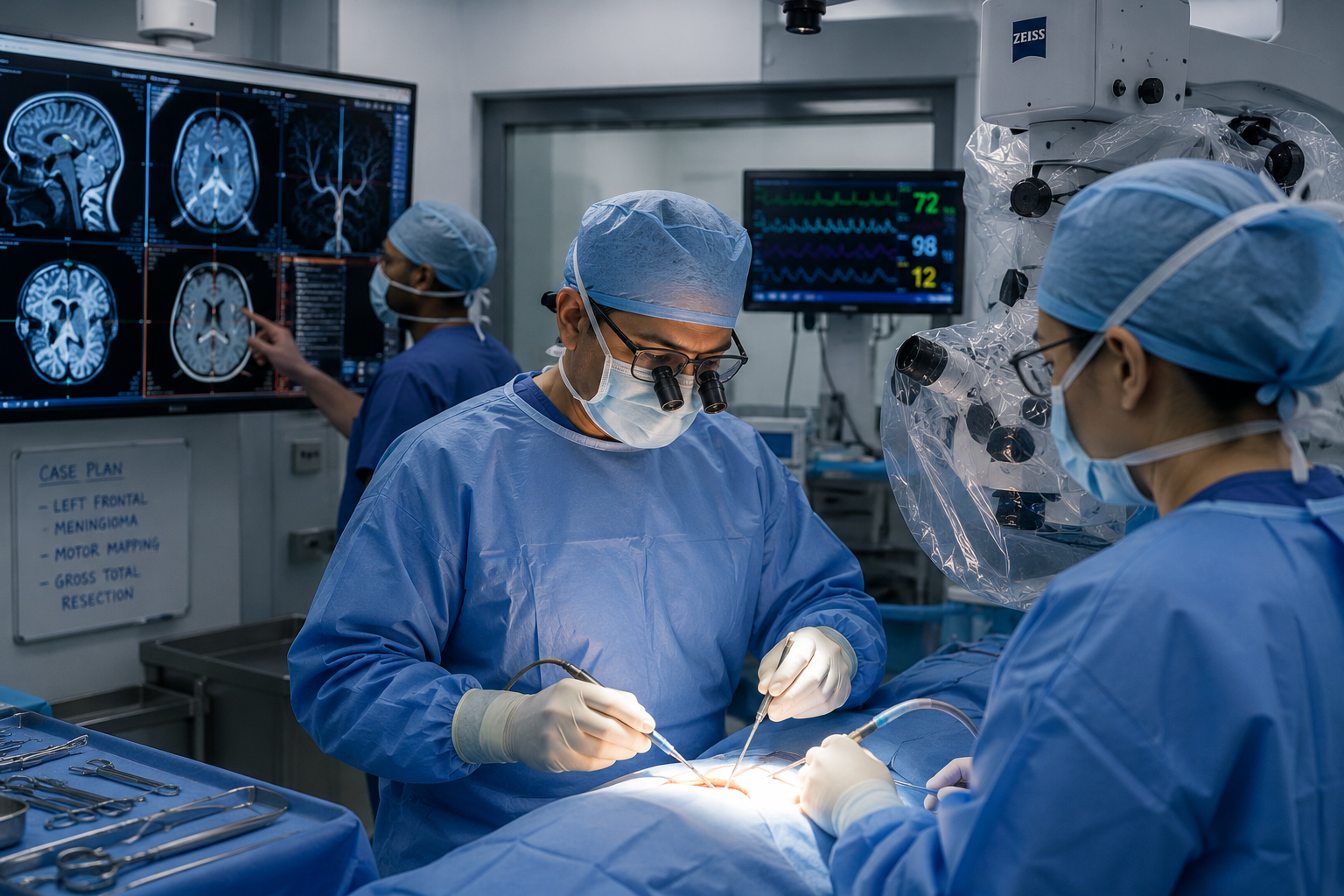
Neurosurgery MSc
Validated by University of Buckingham
Duration
24 MonthsStudy Mode
OnlineTotal Tuition
£10,637Monthly Payment
—Qualification
Master’s Degree (MSc / MA / MPH)Start Date
Jan, Mar, May, Jul, Sep, NovProgramme Overview
The MSc in Neurosurgery is an advanced, part-time, 100% online postgraduate programme delivered by Diploma MSc (Learna) and validated by the University of Buckingham, a UK university with its own medical school and a strong focus on postgraduate education. The two-year, 180-credit programme is specifically designed for healthcare professionals who want to deepen their knowledge of neurosurgery while developing advanced critical appraisal, clinical decision-making and research skills. The programme covers major areas including brain and spine trauma, neuro-oncology, cerebrospinal fluid disorders, paediatric neurosurgery, neurovascular disease, spinal disorders and neurosurgical complications, followed by an independent professional research project. Importantly for Caribbean professionals, the programme is available to healthcare professionals in the UK and overseas and can be completed online without relocating or leaving an existing clinical position. The University of Buckingham confirms that the Neurosurgery MSc is among the Learna programmes it validates.
For Caribbean doctors, nurses and other eligible healthcare professionals, this MSc offers a particularly attractive opportunity to gain specialist postgraduate knowledge while continuing to work in their home country. The flexible online format can make advanced study more practical for professionals working within Caribbean health systems, where access to highly specialised neurosurgical postgraduate programmes may be limited. Students learn through case-based discussions, clinical scenarios and interaction with an international peer group, allowing Caribbean professionals to compare approaches across different healthcare settings and strengthen their evidence-based clinical reasoning. The programme can be especially valuable for professionals working in tertiary hospitals, emergency care, neurology, neurosurgery, intensive care or related services who want to build specialist expertise and strengthen their academic and career profile. Applicants should, however, confirm recognition requirements with their national medical or professional council, because postgraduate qualification recognition is governed by each country's regulations
Entry Requirements
Since our courses are conducted entirely online, they are accessible to both UK and international registered healthcare professionals.
Applicants will typically hold a first degree or equivalent (including international qualifications) in a relevant professional healthcare field, such as a medical or nursing degree.
Registered healthcare professionals without these recognised qualifications will be considered on an individual basis and a wide range of prior experience may be taken into account. In some cases, applicants may be asked to submit a piece of work for assessment in order to confirm that they are able to work comfortably at postgraduate level, and demonstrate the requisite clinical and professional knowledge.
Documents Required
A copy of your updated CV including your address and date of birth.
A copy of your undergraduate degree certificate.
The name and email address of someone who is able to provide a reference, this can be a work colleague, employer or former tutor.
A detailed personal statement explaining why you would like to undertake the course.
A copy of your proof of English competency (see below).
English Language Requirements Proficiency in the English language is also essential to completing our courses. If English is NOT your first language, we ask for proof of competency during the application process. We are able to accept an IELTS overall score of 6.5 (with a minimum of 6.0 for each band) or an equivalent qualification.
If you do not meet these requirements, please don’t worry. The University of Buckingham run a number of English Language Programmes at the Centre for International English to prepare you for your academic studies. You can also contact our admissions team on admissions@diploma-msc.com for more information on the qualifications we accept.
Should you have already successfully completed the 1 year Postgraduate Diploma and wish to convert to the MSc and complete only the second year of the programme this is possible. Please contact our admissions department admissions@diploma-msc.com to find out more.
Who is this course for?
This programme is particularly suited to:
Medical doctors seeking advanced knowledge in neurosurgery.
Neurosurgical trainees.
Doctors working in neurology, emergency medicine, critical care or related specialties.
Specialist clinical nurse specialists working in neurosurgical settings.
Nurses supporting patients with neurological or neurosurgical conditions.
Healthcare professionals working in tertiary-care hospitals.
Healthcare professionals seeking an academic pathway into neurosurgery-related research.
International healthcare professionals who require a flexible postgraduate programme that can be completed online.
Career Opportunities
Neurosurgeon / Neurosurgical Career Pathway
Neurosurgical Trainee
Clinical Nurse Specialist – Neurosurgery
Neurosurgical/Neurological Clinical Practitioner
Neurology or Neuroscience Clinical Roles
Neuro-Oncology Clinical Support
Neurocritical Care / Intensive Care
Neurosurgical Researcher
Clinical Research or Academic Healthcare
Neurosurgical Service Leadership / Clinical Education
Programme Highlights
This module develops advanced knowledge of the assessment, investigation and management of patients with traumatic brain and spinal injuries. Students examine head injury, primary and secondary brain injury, intracranial pressure, severe head injury, spinal injury and neurorehabilitation. For Caribbean healthcare professionals, this is particularly relevant to emergency departments, trauma services and hospitals managing road-traffic injuries, falls and other serious trauma. The module emphasises evidence-based decision-making and ethical responsibility when managing complex trauma cases.
The Neuro-Oncology module focuses on the assessment and management of patients with suspected brain and spinal tumours. Students explore tumour presentations, investigations, high- and low-grade gliomas, extrinsic lesions and pituitary tumours. The module helps healthcare professionals develop a structured approach to complex neurological cancer cases while strengthening their ability to critically evaluate evidence and contribute to multidisciplinary care.
This module examines cerebrospinal fluid physiology, raised intracranial pressure, hydrocephalus and important areas of paediatric neurosurgery. Students also explore CNS embryology, developmental disorders, paediatric CNS tumours, CNS infections and assessment of the acutely unwell child. It provides valuable specialist knowledge for professionals caring for both adult and paediatric patients with complex neurological conditions.
Students develop knowledge of vascular disorders affecting the central nervous system, including subarachnoid haemorrhage, cerebral aneurysms, vascular anomalies, spontaneous intracerebral haemorrhage and cerebral ischaemia. The module combines vascular anatomy, imaging and clinical correlation with evidence-based approaches to assessment and management. This is particularly valuable for healthcare professionals involved in stroke, emergency, intensive-care and tertiary neurological services.
This module provides a comprehensive examination of spinal pathology, including spinal trauma and instability, spinal tumours, degenerative lumbar, cervical and thoracic conditions, infection and vascular abnormalities. Students develop the ability to interpret evidence, assess spinal conditions and understand the relationship between spinal anatomy and disease. The knowledge is applicable to professionals involved in neurosurgery, orthopaedics, emergency medicine, rehabilitation and neurological care.
This module concentrates on acute complications and emergencies affecting neurosurgical patients. Topics include postoperative deterioration, seizures and epilepsy, electrolyte disorders, endocrine emergencies, CNS infection and systemic postoperative complications. Students develop advanced knowledge of safe intervention, acute assessment and evidence-based management—skills that can be highly valuable in hospital environments where rapid recognition of deterioration is critical.
The final MSc module gives students the opportunity to undertake an independent research-based professional project. Students develop skills in research methodology, quantitative and qualitative studies, statistical interpretation, systematic reviews, meta-analysis, evidence appraisal, audit, governance, quality improvement and health economics. The module culminates in a substantial professional project/dissertation, giving Caribbean healthcare professionals an opportunity to investigate a neurosurgery-related issue relevant to their own clinical environment or healthcare system.
Related Courses
Introduction to Global Mental Health and Wellbeing (Short Course)
Qualification: Micro-Credentials / Short Courses
Duration: 13 weeks
Tuition: £1,543
View ProgrammeMental Health over the Life Course (Short Course)
Qualification: Micro-Credentials / Short Courses
Duration: 13 weeks
Tuition: £1,543
View ProgrammeHealthcare Management: Principles and Practices (Short Course)
Qualification: Micro-Credentials / Short Courses
Duration: 13 weeks
Tuition: £1,543
View ProgrammeNeurosurgery PGDip
Validated by University of Buckingham
Duration
12 monthsStudy Mode
OnlineTotal Tuition
£6,237Monthly Payment
—Qualification
Postgraduate DiplomaStart Date
Jan, Mar, May, Jul, Sep, NovProgramme Overview
Neurosurgery is a competitive and demanding speciality, requiring a broad knowledge of anatomy, neurology and physiology, in addition to critical appraisal and research skills. Our Postgraduate Diploma in Neurosurgery is designed for healthcare professionals in the UK and overseas who want to specialise in Neurosurgery and develop both theoretical knowledge and research skills.
Currently, there are no other postgraduate courses in Neurosurgery that offer a comprehensive review of core neurosurgical topics leading to a recognised postgraduate qualification. Our diploma in neurosurgery fills this crucial gap, providing essential early career development in research and educational skills. As medical graduates are required to apply for specialist training much earlier than before, this course offers the necessary foundation and skills to support your applications.
Additionally, the expanding roles of advanced clinical nurse specialists and physician associates require postgraduate qualifications for career progression, making our neurosurgery diploma an ideal choice for developing both theoretical knowledge and research skills across healthcare professions.
At Learna, we credit ourselves for selecting the very best tutors from around the world to guide our students and provide a unique insight into healthcare systems globally, expanding their knowledge and confidence even further.
On successful completion on our part-time, highly competitive and fast-paced programme, you will:
Be able to critically appraise current developments and guidance in neurosurgery.
Critically apply an advanced knowledge of neurosurgical conditions to healthcare decision making.
Evaluate current research in neurosurgery.
Demonstrate reflection and creativity in addressing complex problems in acute neurosurgery.
Entry Requirements
Since our courses are conducted entirely online, they are accessible to both UK and international registered healthcare professionals.
Applicants will typically hold a first degree or equivalent (including international qualifications) in a relevant professional healthcare field, such as a medical or nursing degree.
Registered healthcare professionals without these recognised qualifications will be considered on an individual basis and a wide range of prior experience may be taken into account. In some cases, applicants may be asked to submit a piece of work for assessment in order to confirm that they are able to work comfortably at postgraduate level, and demonstrate the requisite clinical and professional knowledge.
Documents Required
A copy of your updated CV including your address and date of birth.
A copy of your undergraduate degree certificate.
The name and email address of someone who is able to provide a reference, this can be a work colleague, employer or former tutor.
A detailed personal statement explaining why you would like to undertake the course.
A copy of your proof of English competency (see below).
English Language Requirements Proficiency in the English language is also essential to completing our courses. If English is NOT your first language, we ask for proof of competency during the application process. We are able to accept an IELTS overall score of 6.5 (with a minimum of 6.0 for each band) or an equivalent qualification.
If you do not meet these requirements, please don’t worry. The University of Buckingham run a number of English Language Programmes at the Centre for International English to prepare you for your academic studies. You can also contact our admissions team on admissions@diploma-msc.com for more information on the qualifications we accept.
Should you have already successfully completed the 1 year Postgraduate Diploma and wish to convert to the MSc and complete only the second year of the programme this is possible. Please contact our admissions department admissions@diploma-msc.com to find out more.
Who is this course for?
Our diploma in neurosurgery are suitable for doctors of all grades and nurses, in particular clinical nurse specialists wanting to specialise in neurosurgery, such as:
Neurosurgical Trainees
Specialist CNS Nurses
Doctors specialising in Neurosurgery
Medical Researchers focusing on Neurosurgery
Primary Care Physicians interested in neurosurgical conditions
Specialists in related fields such as stroke, acute medicine and paediatrics
Programme Highlights
Programme highlights coming soon.
Related Courses
Introduction to Global Mental Health and Wellbeing (Short Course)
Qualification: Micro-Credentials / Short Courses
Duration: 13 weeks
Tuition: £1,543
View ProgrammeMental Health over the Life Course (Short Course)
Qualification: Micro-Credentials / Short Courses
Duration: 13 weeks
Tuition: £1,543
View ProgrammeHealthcare Management: Principles and Practices (Short Course)
Qualification: Micro-Credentials / Short Courses
Duration: 13 weeks
Tuition: £1,543
View ProgrammeApply for This Programme
You need an UpCaria account before starting your application. Log in to your existing account or create a new one.
🎓 Scholarship Eligibility Checker
Select your country to check whether you may qualify for a scholarship for this programme.